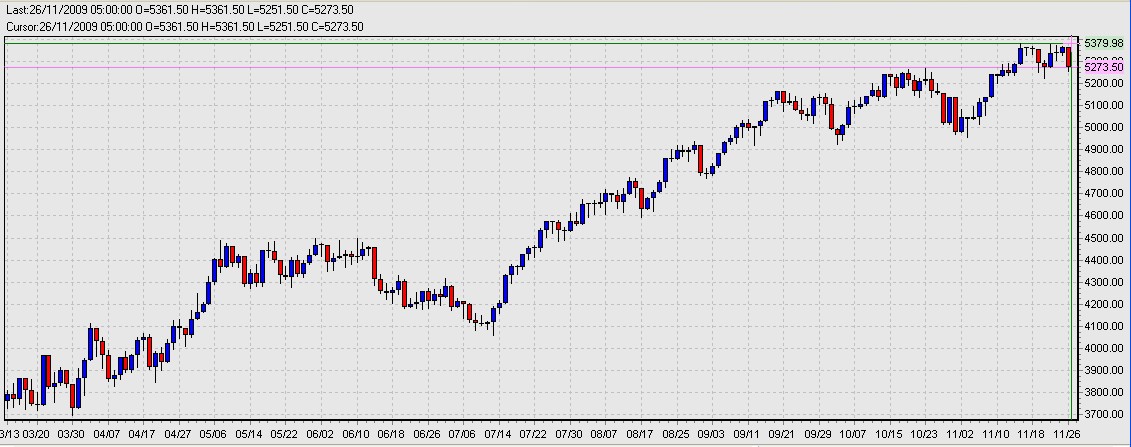
Because global asset markets are so tightly integrated, a weekly preview of major forex pairs also demands a look at key international equity markets, which tend to set the overall bullish or bearish tone, as well as key commodities like oil and gold, which provide a means of evaluating currencies independent of currencies themselves.
GLOBAL STOCK MARKETS
As always, we begin our weekly preview of global markets with a look at the S&P 500 stock index. International forex and commodity markets tend to move according to stocks, and no single index provides a better single picture of overall market sentiment than the S&P 500. Just note how similar most other major international stock or commodity daily charts match that of the S&P 500.
The key points to note about the chart:
• The possible formation of a bearish double-top pattern forming around the 1100 level
• The relatively low volume on the rallies to this level compared to the much higher volume at the tops and on the pullbacks since the beginning of September until now. The red line on the volume histogram is a 10 day Simple Moving Average of Volume that clarifies how volume is relatively low on the rallies and higher on the pullbacks.
S&P 500 Daily Chart With Volume With 10 Day Moving Average for Volume
04 Nov 15
For perspective on the significance of the 1100 level, we zoom back to a weekly chart of the S&P 500 for the past 5 years. Note how this level has served as minor multi-week support resistance. Thus if the past is any guide, the rally will need to pass the 1100 within the next few weeks or risk losing credibility. If that happens, then risk assets are likely to either consolidate in a horizontal range or stage a long awaited normal pullback. Note that a drop of 100-300 points would be a perfectly normal retracement and markets would still be in a firm overall uptrend.
S&P 500 5 Year Weekly Chart with 10 Week Moving Average for Volume
06 Nov 15
Again, note the declining overall volume of the rally since April, suggesting a lack of believers in this rally. The bright side is that there may be a lot of cash still available to fuel further rally if the recovery becomes more convincing. The downside of this low volume rally is that it suggests they buyers were short term hot money that will be inclined to sell if the recovery falters. That in turn will depend on whether economies can begin to hold up without massive new stimulus, and if they can't, whether governments will be able to continue providing it, and for how much longer.
If one can answer those questions correctly, then they'll know whether to be long or short these markets and virtually every asset traded.
COMMODITIES: ENERGY AND PRECIOUS METALS
Crude Oil
Summary
Earlier in the week, WTI crude oil price did attempt to pierce the 80 resistance. However, both industry-specific fundamentals and macroeconomic data were not strong enough to sustain the breakout. Release of bearish US inventory data and reduced consumer sentiment triggered sharp selloff towards the end of the week.
Analysis
Decline in crude oil price accelerated after the US reported surprising drop in consumer confidence in November. Price plummeted to 75.57, the lowest in a month, before recovery. The benchmark contract closed at 76.35, down -0.8% and -1.4% on daily and weekly basis respectively.
Preliminary reading for the University of Michigan sentiment index fell to 66 in November from 70.6 in October. Although strong GDP growth (revised down to +3.1%) in 3Q09 was good news, the 26-year high unemployment rate continued to hurt consumer confidence. Consumers lacked job security and this diminished their desire to spend and to invest.
For energy-specific data, we received the weekly inventory report from the US Energy Department. Moreover, the 3 oil agencies also published their latest forecasts on global oil demands. In short, the data were still mixed, pointing to long-term recovery with short-term headwinds seemingly inevitable.
Crude inventory rose +1.76 mmb in the week ended November 6 with the Midwest leading the build. Oil inventory in that region surged +2.1 mmb of which 1.4 mmb was from Cushing, Oklahoma. Other regions also showed modest builds with decline only seen in the East Coast. Refinery runs dropped to 79.9%, the lowest in a year although many facilities have resumed operations after maintenance. This was probably driven by abundant fuel stocks.
After making a trough of around -$5 in August, the spread between WTI and Brent crude oil has turned positive again since September. However, WTI's premium to Brent has narrowed recently as driven by increasing stocks at Cushing, Oklahoma, the place where WTI oil is stored.
The biggest disappointed came from gasoline stockpiles which surged +2.56 mmb. Gasoline demand fell -1.9% from a week ago to 8.844M bpd. The reading was also -1.7% below the level a year ago. 4-week average at 8.917M bpd represented declines of -1.1% and -1.5% on weekly and annual basis respectively.
Distillate inventories climbed -0.35 mmb, the first increase in 5 weeks, as demand slipped. Weather in the Northeast was warmer-than-expected in November and this dampened demand for heating oil.
All of the US Energy Department, OPEC and the International Energy Agency revised upward their forecasts of global oil demand for 2009 and 2010. Although the sizes of upgrades were different among these agencies, the common factor was heavy reliance on demand growth from China.
Macroeconomic data in China were broadly encouraging. Expansions in industrial outputs, power generations and retail sales accelerated in October, fueling speculations that the nation's GDP growth can reach +10% the first in more than a year in 4Q09. Moreover, robust industrial activities and electricity usage signaled strong demands for energy and base metals. However, as Chinese Premier Wen Jiabo said, there are still uncertainties for the road to recovery.
Natural Gas
Summary
Gas price slumped to 4.287 as the Energy Department reported +25 bcf (consensus: +20 bcf) rise in gas storage to 3813 bcf in the week ended November 6. Although the level of increase tightened the year-over-year surplus and the surplus as compared to 5-year average, it sent the absolute gas storage to a fresh record high. The benchmark NYMEX contract climbed +0.5% from Thursday but recorded a weekly drop of -4.4%.
We remain bearish on natural gas price as demand is still bottoming while supply continues to stay at record level. Warm weather serves to worsen the already-weak fundamentals and this should result in delay in recovery.
Analysis
According to Baker Hughes, the number of gas rigs dropped 6 units in the week ended November 13. However, it did not help resolving the problem of oversupply. Since mid-July, the US gas rig count has gained +9.5%. Industry data showed that the economic threshold for US shale plays has been declining, suggesting greater production per rig per USD spent. Rising production efficiency has encouraged E&P companies to increase investment budgets. This exacerbates the demand/supply imbalance.
Gold
Summary
Gold continued its journey to uncharted region and reached a fresh high at 1123.4 Thursday before retreat. However, the strong rebound at NY session Friday signaled investment demand for the precious metal remained robust and we expect the long-term uptrend should resume after consolidation.
Analysis
Gold price rebounded strongly in NY session Friday amid renewed weakness in USD. The benchmark contract surged to as high as 1119.7, just a few dollars below the record high, before settling at 1116.7. The Commerce Department reported that the nominal trade balance in goods and services widened to -$36.5B (consensus: -$31.7B) in September from -$30.8B in the previous month. Although both imports and exports increased significantly, growth in imports (+5.8% mom) outpaced that that In exports (+2.9% mom). The wider-than-expected trade deficits weighed on the dollar.
Although RSI (currently at 73) suggests that valuation of gold has been stretched and pullbacks or corrections cannot be ruled out in the coming week, prevailing dollar weakness, low real interest rate environment and strong investment demand should continue to support gold's uptrend towards end 2009.
IMF's gold sales to the Reserve Bank of India still positively affected gold price. India's gold purchase signaled the ongoing shift of central banks and governments as net gold sellers to net gold buyers. Speculations for further central bank buying boosted investment demand.
Real interest rate in the US remains low and this environment is supportive for gold.
Silver
Summary
Comex silver slid to as low as 17.03 before strong rebound Friday. The benchmark contract ended the week flat. Gold-to-silver ratio declined to 60-ish from above 80 at the end of last year. Although current level represents modest increase from 58 in September, it's still above historical average and suggests silver is modestly overvalued. While recent rally in silver has been driven by upsurge in gold, its fundamentals remain weak.
Analysis
On the supply side, key miners reported that silver mine supply increased +7% yoy in 3Q09. On the demand side, China's silver imports fell -23% to 421 metric tons in September while its exports rose more than 4 times to 455 metric tons, suggesting the country has shifted from a net importer to a net exporter of silver. Although industrial activities are expected to improve as global economic recovers, ample silver supply remains the key concern.
FOREX
Overview
The economic calendar heats up with a tremendous amount of data from across the globe and speeches by Fed officials. The major currency pairs are ready for a breakout and there is certainly sufficient catalyst to trigger one. The only question is, will these event risks kill the rally or pave the way for more gains.
THE event to watch this week: does the S&P 500 and EUR/USD form bearish double tops at their respective resistance levels and begin a period of consolidation, normal 10%-20% pullback, or something more severe.
Other Events to Sustain or Kill the March Rally
The most important: the U.S. retail sales report and speech by Fed Chairman Ben Bernanke on Monday.
If October retail sales are very weak or Bernanke talks up the dollar, the rally in equities and high yielding currencies could come to a screeching halt. However we believe that the chances of this happening are low.
--First, it's usually the Treasury Secretary and not the Federal Reserve Chairman that comments on the USD.
--Second, the Fed has been USD dovish.
If anything Bernanke favors a weaker dollar in this low inflation environment. The focus then turns to what he says about the economy and monetary policy. According to the last FOMC statement, there have been no meaningful improvements in the outlook for the U.S. economy since the previous meeting. Asset prices have moved higher but that does not always suggest a stronger outlook for U.S. companies. Recent comments from other Fed officials remain relatively downbeat as growing unemployment caps optimism.
Bernanke's likely tone will be continued caution, to remind us that the recovery is still vulnerable and therefore interest rates need to remain low for a very long and therefore implementing an exit strategy now is inappropriate. If Bernanke maintains this line, then the dollar will continue to be sold to fund carry trade.
--Retail sales may surprise despite the grim labor market
Despite a difficult labor market, both Redbook and the International Council of Shopping Centers (ICSC) reported a sharp rise in retail sales last month while similar results were reported by individual retailers. Good spending numbers would suggest that the economy is moving in the right direction even though the labor market is weak.
Also due this week is inflation, housing and manufacturing sector reports along with the Treasury International Capital flow report. Eight Federal Reserve Presidents are scheduled to speak on a variety of topics while Treasury Secretary Either will be testifying to the Senate Foreign Relations Committee on Tuesday. Don’t forget that President Obama will be in Asia until next Thursday. Watch for any market moving comments, particularly during the Asia-Pacific Economic Cooperation forum (APEC), but we don't expect any dramatic breakthroughs on currency.
USD
Possible S&P 500 Double Top Signaling the Risk Aversion Needed for US Dollar Rally?
Summary
US Dollar Outlook: Bullish if stocks drop, bearish if they don't
- Key Events: Monday-Core Retail Sales, Retail Sales, Tuesday- PPI m/m, TIC Long Term Purchases, Wednesday-Building Permits, Core CPI m/m
- S&P 500 possible double top around 1100 forming?
- IMF pegs the US dollar as the top funding currency for a yield hungry market
- Sharp rise in the trade deficit, drop in consumer confidence contradict the recovery story
- The US dollar to finally reverse course or once again collapse? COT reports reduction in USD shorts.
Analysis
This past week the dollar made its strongest rally in months against the euro, its prime counterpart, but the move faded. Lacking any reason to boost USD demand, the market kept the USD in its eight-month old bearish trend channel. To achieve a sustained reversal, the USD will need either:
• A sustained period of at least consolidation if not reversal in global stocks and other risk assets that drives up demand for safe haven currencies as carry trades unwind. The S&P 500 has twice backed off from the 1100 level. Failure to break through soon could lead to at least a consolidation period if not outright reversal.
• A fundamental improvement in the US economy that brings recovery in the critical jobs, banking, and housing areas, quite possibly in that order, that provides reason for markets to believe USD interest rates will rise sooner than currently expected and thus lift the dollar out of its current status as a prime funding currency for carry trades.
• A selloff in the EUR, because for every 3 Euros bought, a USD is sold, thus any selloff on one automatically helps the other. Since March, this relationship has been a key driver of the EUR's rally.
Events
For the coming week, the most pressing question for any trader is whether either of these drivers of dollar demand will step forward.
The above noted key USD events this week are unlikely to provide either of these reasons for a USD rally.
Therefore, the dollar's prospects for the coming week are likely to move with overall risk appetite through the global financial markets. Looking beyond US economic events, there seem to be few scheduled events or indicators from elsewhere that might alter the current level of fear or greed. In sum, another relatively quiet week of scheduled news releases.
That doesn't rule out the chance of a volatile trading week or trend shift.
When there is a major market-moving event due, the price action leading up to its release is often muted as traders do not want to increase risk. Moreover, if the news doesn’t fall far from forecasts or it otherwise doesn’t play into the larger market themes, then it fails to move markets. Actually, it is those light economic calendar weeks that we see sentiment build momentum and define new trends. The extended nature of the S&P's March rally and thus far firm resistance around 1100 may be all that is needed.
Retail sales will serve as a barometer for consumer spending (accounting for approximately three-quarters of GDP) and the October CPI numbers will reveal whether there is any merit to hawkish concerns through fears of looming inflation.
Given the continued hits to US jobs and wages, it is difficult to see how either will bring prospects for US rate increases and ensuing USD rally any closer.
EUR
Euro Remains Below 1.5050 - Is It a Double Top to Confirm that Forming on the S&P 500?
Summary
Euro Outlook: Neutral-Bullish if USD Continues Down, Bearish if Stocks Consolidate or Fall
- Key Events: Monday-CPI y/y, Thursday- Trichet speaks, Friday German PPI, Trichet speaks
- The German trade surplus expanded to 10.6B in September
- German GDP rose for a second straight quarter in Q3, but exports struggling under high EUR
- Euro-zone GDP figures worse than expected but better than Q2 and do show EZ growing again-Does ECB raise rates or leave them to help smaller nations still in recession?
- Did the EURUSD form a double top? The S&P 500 is forming one around 1100, and this pair strongly correlates to it. If it fully forms, this will be THE event for global markets in general, not just the EUR.
Analysis
The euro ended the past week slightly higher against the US dollar, but down significantly versus the commodity dollars as Credit Suisse Overnight Index Swap (OIS) rates shifted to price in fewer rate increases. Following the European Central Bank’s latest policy decisions, OIS rates eased back to pricing in 83.1 from 98.5 basis points worth of increases over the coming year. From a technical perspective, EURUSD remains in an uptrend, but 1.5050 is meaningful resistance and a failure to break above in the coming weeks may signal a double top for the pair.
Two offsetting events for the euro at the end of the week, as data showed that the Euro-zone’s third quarter recovery wasn’t quite as healthy as expected while there were some hawkish comments by an ECB official. Specifically:
• Euro-zone GDP rose by 0.4 percent from the second quarter, missing the 0.5 % expected increase. Since this was the advanced reading of the index, there was no breakdown available, but the increase was probably from a slight recovery in export demand. However, consumption may have remained weak, because services PMI for the euro-zone did not rise above 50 – signaling an expansion in business activity – until September.
• ECB Executive Board member Jose Manuel Gonzalez-Paramo said that he couldn’t rule out raising rates while some Euro-zone countries are still in recession, and while such a move would be “less fitting” for those countries, the national governments “will have to understand that.”
Events
In the coming week, only one indicator shows major market-moving potential: Euro-zone CPI. The annual rate of inflation growth is projected to rise to -0.1 percent from -0.3 percent. If the data shows that the euro’s appreciation has actually driven down import costs and price pressures more than expected; the currency could pull back because this could further undermine current market expectations for ECB rate increases.
JPY
Yen Likely to Range Trade vs. the US Dollar Given Lack of Market Moving News
Summary
Yen Outlook: Bearish/Neutral
- Key Events: Monday-BoJ Gov. Speaks, Tuesday-Tertiary Industrial Activity, Friday-BoJ Press Conference
- Yen looks increasingly vulnerable with growing risk appetite
- Yen outperforms against British Pound despite its lower yield
- Forex crowds pointed to potential for USDJPY losses
Analysis
Continued S&P 500 rallies made the safe-haven JPY the second-worst performing G10 currency to finish the week’s trade, beating out only the similarly-battered US Dollar. All major world equity indices finished anywhere from 2-3 percent above their weekly open except for the Japanese Nikkei 225—raising serious doubts on investor demand for Japanese financial asset classes, which reflected poorly on the domestic currency. Indeed, the fundamental arguments for Japanese Yen strengths are becoming increasingly scarce—especially through times of healthy financial market risk appetite.
We have long held that financial market risk sentiment and the trajectory of the S&P 500 would be the major determinant of USDJPY price action. Yet the US Dollar has now become the top funding currency for carry trades as it now carries the lowest overnight yield of any major world currency. This significant shift in interest rates has meant that the USDJPY’s correlation to risky assets has fallen considerably from its heights, and it is admittedly unclear whether the USDJPY would decline on S&P 500 tumbles. In fact, the rolling correlation between the US Dollar Index and S&P is very near record-highs—emphasizing the Dollar’s sensitivity to risk sentiment.
The Japanese Yen may struggle to find a bid against the US Dollar as it trades near substantive highs. This unclear US Dollar/Japanese Yen link to risk sentiment may explain low volatility expectations for the currency pair, and it seems traders are pricing in range trading for the often fast-moving USDJPY. This contrasts with the volatility expectations for other major currencies, and theoretically provides a safe haven for range traders and scalpers for the coming week.
GBP
Bullish Pound Forecast Versus Euro Subject to BoE Surprises?
Summary
Pound Outlook: Neutral
- Key Events: Mon.-Rightmove HPI m/m, Tue.- CPI y/y, BoE Inflation Letter, Wed.-MPC Meeting Minutes, Thur.-Retail Sales m/m
- GBP rally stops on Fitch concern on UK sovereign debt rating
- Similar caution from the Bank of England also hurts Pound, more could come from news this week
- Technical support still there for the GBP
Analysis
The British Pound survived a week of unimpressive news to trade a bit higher against the US Dollar, but a busy coming week of economic event risk may pose further challenges for the UK currency in the week ahead. Early prior-week news that Fitch Ratings took a “cautious” view on its outlook for the UK Government Bond’s AAA sovereign rating shook markets and sent the Sterling plunging about 200 bps. The following Bank of England Quarterly Inflation report expressed a similarly cautious outlook for economic growth, and it seemed like the GBP was headed for a break of key support against the US dollar. Yet the GBPUSD held key technical levels through the week’s close. Whether or not the pair can sustain its level will likely depend on events in the days ahead, setting the stage for another eventful week of British Pound price action.
Events
Consumer Price Index figures and mid-week Bank of England monetary policy minutes will be the major highlights in the week ahead, but traders should watch for UK Retail Sales results too.. Inflation and BoE outcomes are likely to cause volatility in UK interest rate expectations and thus the Pound. The currency rallied sharply through the Bank of England’s most recent interest rate announcement as officials boosted Quantitative Easing measures by only half of the expected £ 50 billion.. Traders will want to see the voting for that decision and general commentary on the future of monetary policy, while the previous day’s CPI data will likewise play a large part in determining monetary policy forecasts. Forecasts call for a modest rise in year-over-year inflation rates, and it is admittedly difficult to predict likely reactions to the event. Lofty expectations for later-week Retail Sales numbers, on the other hand, leave room for disappointment.
The Pound has been able to hold major technical and psychological support versus the Euro and US Dollar, but that will likely be tested in the week ahead. According to US CFTC Commitment of Traders data, Non-Commercial traders are still heavily long the EUR/USD and short the GBP/USD—giving us a fairly bearish EUR/GBP bias. Yet positioning has thus far eased considerably from previous extremes, and the British Pound is at clear risk for losses on continued disappointments in domestic fundamental developments. All else remaining equal, we expect the British Pound to break the psychologically significant 0.8900 mark against the Euro, but our forecasts will likely be put to the test in the week ahead.
CHF
SNB Pledge to Maintain Policy Suggests Range Trading Ahead, But Sudden Risk Aversion Might Overwhelm SNB Efforts to Keep the CHF Low
Summary
Swiss Franc Outlook: Neutral
- Key Events: Tuesday-Retail Sales y/y, Thursday-Trade Balance, SNB Chairman Roth Speaks
- Swiss Investor Confidence Weakens in November
- Producer & Import Prices Unexpectedly Contract in October
- Continued Dovish Policy May Leave the CHF Range Bound Barring any Positive Surprises From The Above Events
Analysis
The Swiss Franc ended the week higher against the U.S. Dollar and the Euro, with the USD/CHF continuing to push toward parity as the pair slipped to a low of 1.0034, just 2pips shy of the yearly low at 1.0032. The CHF appears likely to remain range-bound over the following week as investors weigh the outlook for future policy. SNB member Thomas Jordan made the following points:
• Reaffirmed the central bank’s policy stance during a speech earlier this week and said that the board has reached its goals and does not see any reason to shift policy.
• Continued to voice his concern about the marked appreciation in the Swiss franc, stating that “the exchange rate has quite an important impact” on the economy, and went onto say that the central bank’s efforts to stem the rise against the euro were successful.
• That the SNB will look to normalize policy over the medium-term as conditions improve, but noted that the outlook for the global economy remains highly uncertain and pledged to support the economic recovery in the short run.
Similarly dovish, SNB Governor Jean-Pierre Roth expects to see weaker growth following the crisis, and said that the slump in employment remains a concern as growth prospects remain subdued. As policy makers maintain a cautious outlook for the region and vow to prevent a further appreciation in the exchange rate, the franc seems likely to continue to range trading as markets consider the chance of another SNB intervention. Still, the economic calendar for the following week could spark volatility in the Swiss franc cross rates as the Swiss National Bank holds an improved outlook for growth and forecasts GDP to expand at an annual rate of 0.4% in 2010 amid an initial forecast for a 0.4% contraction.
CAD
Canadian Dollar Continues To Move With Oil, Then Stocks, Then Events
Summary
Canadian Dollar Outlook: Bullish Barring Stock Pullback
- Key Events: Monday-Manufacturing Sales m/m, Wed.- Core CPI m/m, Thurs. Leading Indexes m/m
- Is USDCAD bound to strengthen? Much depends on S&P 500, which drives oil
Analysis
The Canadian dollar was one of the strongest major currencies over the past week, but this was mostly the result of broad US dollar weakness rather than commodity prices, as oil continued to consolidate between $77/bbl and $80/bbl. Furthermore, there was no major economic data on hand. However, one significant indicator was released on Friday, when data showed that Canada’s trade deficit narrowed to a three month low in September. The deficit eased to C$927 million from C$1.99 billion in August due to a 3.5 % increase in exports, suggesting that foreign demand may ease some of the nation’s economic woes. As usual, a break in either direction for oil is likely to translate into a similar move for the Canadian dollar versus the US dollar, but the trend remains in favor of CAD strength and/or USD weakness, barring a significant stock pullback.
Events
Overall, upcoming economic reports out of Canada are anticipated to reflect improving conditions.
• Monday, manufacturing sales for the month of September are projected to rise by 1.7 percent following a drop of 2.1 percent in August, but the actual results could prove to be even better given the jump in exports during the same period.
• On Wednesday, the annual rate of Canadian headline CPI growth for October is projected to bounce back up to 0.1 percent from -0.9 percent, while the Bank of Canada’s core measure is projected to rise to 1.7 percent from 1.5 percent. Such results would suggest that higher commodity costs are providing some support for the headline CPI measures, while improving domestic demand has lifted broader prices. The Bank of Canada sees that “overall risks to its inflation projection are tilted slightly to the downside,” but if CPI climbs higher than expected, the Canadian dollar could rally on improved expectations for interest rate increases.
• Finally, on Thursday, international securities transaction may show that foreign demand for Canadian assets waned in September to C$3.0 billion from C$5.082 billion. On the other hand, wholesale sales are estimated to rise 1.0 percent for September, which would bode well for the November 23 release of retail sales as a gauge of domestic demand.
AUD
Australian Dollar Continuing Higher Barring New Risk Aversion
Summary
Australian Dollar Outlook: Bullish
- Key Events: Tues.-Monetary Policy Meeting Minutes, Wed.- Wage Price Index q/q (expected increase may fuel further rate increase expectations, AUD strength)
- Growing Interest Rate Advantage Feeding AUD Carry Trade Demand, AUD to rise with stocks
- Australian economy unexpectedly added 24,500 jobs in October, equaling a six year high, renews rate hike expectations, and AUD rally
- Westpac Consumer Confidence Fell for the first time in six months by 2.5%
- Consumer inflation expectations fall to 3.2% from 3.5% in October
Analysis
The Australian dollar hit another annual high of 0.9368 against the USD as continued risk appetite and unexpected job creation in October fed bullish sentiment. Equity markets continued push higher with the Dow setting a fresh yearly high as traders took comfort in the G-20’s pledge to maintain low interest rates and stimulus programs. However, the RBA isn’t expected to follow the pack as they have already raise rates at their last two policy meetings and markets are currently pricing in an 83% chance that they will continue to tighten at their December meeting. The prospect of higher borrowing costs led to 2.5% drop in consumer confidence, the first in six months. Confidence remains relatively high, but declining optimism could negatively impact domestic consumption which unexpectedly fell 0.2% in September.
The weak demand had raised the prospect that the RBA would take a break from their tightening policy at their December meeting as there are concerns that premature rate hikes could derail the recovery. Additionally, Governor Stevens last week signaled to markets that the strength of the Australian dollar would limit upside inflation risks and give him the scope to slow the pace of future rate increase. But the surprising job growth renewed expectations for an additional 25 bps hike as it confirmed Governor Stevens' statements following November’s meeting that “there have been some early signs of an improvement in labor market conditions. The rate of unemployment is now likely to peak at a considerably lower level than earlier expected.”
Events
The upcoming economic calendar may only add to the likelihood of a rate increase as the wage cost index is forecasted to show a 0.7% rise in the third quarter, adding to inflation concerns. Westpac’s leading index which tracks eight gauges of activity, such as company profits and productivity, to give an indication of how the economy will perform over the next three to nine months is also due for release. If it continues its current trend of improvement then the brighter outlook for growth will add to the case for future tightening. Rising interest rate expectations will continue to be a supporting factor for the Australian dollar which could see the com-dollar eventually look to test its all-time high. However, the RBA will release their minutes from their November meeting which could hint at the prospect of keeping rate steady at their next meeting which could weigh on the Aussie.
Additionally, the AUD could drop fast if risk appetite wanes which could be the case this week with equity markets up against technical resistance levels.
NZD
New Zealand Dollar Fundamentals To Overwhelm Risk Appetite?
Summary
New Zealand Dollar Outlook: Bearish
-Disappointing retail and manufacturing indicators bear out RBNZ Governor Bollards economic concerns
-Is NZDUSD setting up a bearish reversal of its eight month bull run? Watch to see if the S&P 500 rolls over at the forming bearish double top around 1100
Analysis
Even more than other high yield currencies, the NZD may be living on borrowed time, given the S&P's forming bearish double top. If 1100 indeed proves to be the end of the rally, the NZD would likely suffer more than most other currencies. Risk appetite alone lifted this currency from a six-year low, and it is only a matter of time before the aggressive rally collapses under its own weight.
The NZD's high yield and its mere presence among the list of most liquid currencies have made it a place to park idle cash. In fact, under most scenarios (even a revival in the demand for yield); the NZD may actually lead the over-due correction.
While it is possible that the New Zealand dollar could struggle or tumble even if sentiment is steady or rising; it is best to first cover the most direct fundamental scenario: a plunge in risk appetite. Though the S&P 500 and Gold closed their respective weeks at or near new highs for the year; there is growing skepticism among the trading ranks that the drive can hold up for much longer. As we noted in the above section on global stocks indexes, volume for the S&P 500 (and gold too) hit new monthly lows. From a more historical perspective, we haven’t seen a rally from equities of this magnitude in recent history.
We have argued for many months that from technical and fundamental perspective, values have run ahead of the economics that support them. The return of idled investor funds from the harbor of safe haven assets back into the speculative arena has filled in for the lack of reasonable yield income with the thrill of capital gains. However, eventually a balance will be struck where the speculators will be tapped and what remains to be invested will belong to those managers that are cautiously awaiting the return of dividends, yields and other stable rates of return. When the tides turn, the collapse from profit taking will likely be more severe (though perhaps not as deep) as the initial rally.
When carry trades begin to be unwound in masse, those securities with a weak fundamental foundation will see bleed capital the fastest. Therefore, a currency like the Australian dollar may see a retracement but it could well be relatively mild thanks to its ability to avoid recession and the promise of a hawkish rate regime. However, as we've noted repeatedly, the NZD lacks the fundamental strength of the AUD, even though it has risen in tandem with the AUD.
• The NZ economy is still struggling to recover.
• The central bank has vowed to hold its benchmark lending rate at its record low 2.50 percent until late 2010.
Thus any real retreat in risk appetite makes the overbought NZD a clear favorite for shorting, especially against the oversold USD. Meanwhile, we will keep tabs on the economy’s and central bank’s pace. Event risk over the coming week is relatively light but upstream inflation numbers and credit card spending figures will offer a look at two key concerns for the policy authority.
CONCLUSIONS
Watch the S&P 500 carefully to see if a sustained retreat or range trading stage below the bearish double top beginning to form around 1100 causes this to turn into a truly bearish formation. As noted above
The low volume nature of the March rally suggests there is plenty of short term money that is ready to take profits. If that movement develops, we suggest readers do the same and /or go long safety currencies.
If news events surprise to the upside, risk assets could once again hold on and move forward. Betting against the resilience of the market has been an expensive mistake overall since March. That's why we wait for various forms of confirmation of trend shifts before trading them.
RECOMMENDATIONS
Long risk assets when they hit support levels but be ready to close positions and go short if the double top in the S&P 500, EUR/USD, and other charts holds firm and develops into a pullback.
DISCLOSURE: AUTHOR HAS NO POSITIONS IN THE ABOVE INSTRUMENTS
Sunday, November 15, 2009
Tuesday, November 3, 2009
BIWEEKLY GLOBAL MARKETS REVIEW & IMPLICATIONS 10/19-11/02: STOCKS, CURRENCIES, COMMODITIES
Market Diary: What Happened Since Our Last Biweekly Review
Global Stock Markets
Because most major international stock indexes move with the S&P 500 Index, the chart below of the S&P 500 Index Futures Contracts gives us an overview of all major global stock indexes since our last Newsletter of 10/19.
Here's a chart of the S&P 500 Futures as of 10/19. At the time this image was made the market was climbing and would end the day closing at 1095, which would prove to be its very top close for the next two weeks.
The S&P 500 Futures 10/05—10/19
03 oct 19
Here's a chart of this bellwether index since then:
The S&P 500 Futures 10/19—11/02
Image: 04 Nov 02
As the chart above shows, the market began its pullback the very next day, erasing the gains of October 19th and beginning a 5.9% drop to a low of 1030 as of this writing.
This performance roughly reflects the direction and magnitude of losses across the spectrum of risk assets. Why the drop?
As we review our daily analyses from this period, the main reasons appear to have been:
• U.S. Q3 earnings reports showed stabilization but were not good enough to justify higher stock prices at this time. The signs have been there for those who willing to see them. For Q2, investors were satisfied that the threat of financial collapse appeared to have receded, and that companies managed to beat lowball earnings estimates even though businesses were clearly still getting worse. No longer. This time around, the media had been raising questions about whether companies could show actual growth of their sales and overall business that could justify the highest valuations the S&P has seen in years, despite the ongoing downturn. The doubts were more than legitimate. Historically, the average Price/Earnings ratio for the S&P is around 15-20. While the recovery is far from robust or even fully underway, the current figure is around an astounding 143. Yet all the fundamental problems in housing, banking and employment that caused the current downturn are still fully unresolved. Too many firms reported continued declines in revenues or profits based on unsustainable actions like cost cutting , asset sales, or accounting tricks.
• The balance of news over this period was the typical mixed bag that showed halting improvement but not enough to justify belief in further gains in risk assets. Meanwhile there was plenty of bad news to confirm that it was time to take some profits. Employment continues and housing continued to worsen, UK GDP showed continued contraction, and even the better than expected US GDP was discounted as the result of temporary government stimulus rather than genuine private sector recovery.
A Normal Retesting of Support or New Down Trend?
The big question is no longer whether the rally can continue—it can't, not until there are signs of further recovery. Instead, the focus is on whether the current pullback can stabilize soon as a normal pullback within a continuing uptrend, or whether we are beginning the next move down into a double dip "W" shaped recovery, or longer period of stagnation or decline.
The coming weeks will not give us the big picture, but are very likely to set the near term direction. This week is packed with central bank policy statements and employment figures, including the month's climactic US Non-Farms Payrolls and Employment rate figures for October.
Some Trading Opportunities Over the Past Two Weeks
Needless to say, this kind of volatility was trader's paradise, and much of it was in clear sustained directional moves or within identifiable ranges.
EUR/USD [200:1 leverage]
• Fell from 1.5041 to 1.4685, a move of 356 pips or 2.36%, in just 3 trading sessions from 10/26-10/28. Potential profit: 473%.
• On 10/29 rose over 1% on the positive US GDP surprise, then on 10/20 retraced the gain along with the rest of the markets for another 1%+ move on the way down, an over 2% round trip. Profit potential: over 400%.
The S&P 500 CFDs [100:1 leverage]
• Pulled back about 5.9% in 5 trading sessions from 10/22-28.Profit potential: almost a 600% in under a week.
• Within the past 2 weeks, it has also made no less than 5 moves of nearly 2% up or down over the past two weeks, each one potentially worth approximately 200% profit for those catching the entire move. Profit potential: nearly 1000% for the entire round trip.
Crude oil CFDs [100:1 leverage]
• Dropped over 5.5% in just 5 trading sessions from 10/23-10/28. Profit Potential: 550%.
• On 10/29 rose from $77-$80, 3.89%, following the positive US GDP surprise, then retraced the move back down with the rest of the markets, falling from $80-$77, a 3.75% decline, for a total round trip move of nearly 8%. Profit potential: nearly 800%.
Of course, few would be so lucky to catch even the majority of these moves, but even a very realistic fraction of these moves that one could expect to get using prudent risk management techniques would prove extremely rewarding.
Conclusion
In another two weeks we'll have seen the results of the above mentioned critical reports and events, and will know whether markets are just undergoing normal consolidation or making a deeper test of support
This is exactly why AVA FX strives to provide such a diverse range of trading instruments. While other markets are struggling, our clients can always find a bull market somewhere
Disclaimer and Disclosure: The opinions expressed do not necessarily reflect those of AVAFX. The author holds no positions in the above instruments.
Global Stock Markets
Because most major international stock indexes move with the S&P 500 Index, the chart below of the S&P 500 Index Futures Contracts gives us an overview of all major global stock indexes since our last Newsletter of 10/19.
Here's a chart of the S&P 500 Futures as of 10/19. At the time this image was made the market was climbing and would end the day closing at 1095, which would prove to be its very top close for the next two weeks.
The S&P 500 Futures 10/05—10/19
03 oct 19
Here's a chart of this bellwether index since then:
The S&P 500 Futures 10/19—11/02
Image: 04 Nov 02
As the chart above shows, the market began its pullback the very next day, erasing the gains of October 19th and beginning a 5.9% drop to a low of 1030 as of this writing.
This performance roughly reflects the direction and magnitude of losses across the spectrum of risk assets. Why the drop?
As we review our daily analyses from this period, the main reasons appear to have been:
• U.S. Q3 earnings reports showed stabilization but were not good enough to justify higher stock prices at this time. The signs have been there for those who willing to see them. For Q2, investors were satisfied that the threat of financial collapse appeared to have receded, and that companies managed to beat lowball earnings estimates even though businesses were clearly still getting worse. No longer. This time around, the media had been raising questions about whether companies could show actual growth of their sales and overall business that could justify the highest valuations the S&P has seen in years, despite the ongoing downturn. The doubts were more than legitimate. Historically, the average Price/Earnings ratio for the S&P is around 15-20. While the recovery is far from robust or even fully underway, the current figure is around an astounding 143. Yet all the fundamental problems in housing, banking and employment that caused the current downturn are still fully unresolved. Too many firms reported continued declines in revenues or profits based on unsustainable actions like cost cutting , asset sales, or accounting tricks.
• The balance of news over this period was the typical mixed bag that showed halting improvement but not enough to justify belief in further gains in risk assets. Meanwhile there was plenty of bad news to confirm that it was time to take some profits. Employment continues and housing continued to worsen, UK GDP showed continued contraction, and even the better than expected US GDP was discounted as the result of temporary government stimulus rather than genuine private sector recovery.
A Normal Retesting of Support or New Down Trend?
The big question is no longer whether the rally can continue—it can't, not until there are signs of further recovery. Instead, the focus is on whether the current pullback can stabilize soon as a normal pullback within a continuing uptrend, or whether we are beginning the next move down into a double dip "W" shaped recovery, or longer period of stagnation or decline.
The coming weeks will not give us the big picture, but are very likely to set the near term direction. This week is packed with central bank policy statements and employment figures, including the month's climactic US Non-Farms Payrolls and Employment rate figures for October.
Some Trading Opportunities Over the Past Two Weeks
Needless to say, this kind of volatility was trader's paradise, and much of it was in clear sustained directional moves or within identifiable ranges.
EUR/USD [200:1 leverage]
• Fell from 1.5041 to 1.4685, a move of 356 pips or 2.36%, in just 3 trading sessions from 10/26-10/28. Potential profit: 473%.
• On 10/29 rose over 1% on the positive US GDP surprise, then on 10/20 retraced the gain along with the rest of the markets for another 1%+ move on the way down, an over 2% round trip. Profit potential: over 400%.
The S&P 500 CFDs [100:1 leverage]
• Pulled back about 5.9% in 5 trading sessions from 10/22-28.Profit potential: almost a 600% in under a week.
• Within the past 2 weeks, it has also made no less than 5 moves of nearly 2% up or down over the past two weeks, each one potentially worth approximately 200% profit for those catching the entire move. Profit potential: nearly 1000% for the entire round trip.
Crude oil CFDs [100:1 leverage]
• Dropped over 5.5% in just 5 trading sessions from 10/23-10/28. Profit Potential: 550%.
• On 10/29 rose from $77-$80, 3.89%, following the positive US GDP surprise, then retraced the move back down with the rest of the markets, falling from $80-$77, a 3.75% decline, for a total round trip move of nearly 8%. Profit potential: nearly 800%.
Of course, few would be so lucky to catch even the majority of these moves, but even a very realistic fraction of these moves that one could expect to get using prudent risk management techniques would prove extremely rewarding.
Conclusion
In another two weeks we'll have seen the results of the above mentioned critical reports and events, and will know whether markets are just undergoing normal consolidation or making a deeper test of support
This is exactly why AVA FX strives to provide such a diverse range of trading instruments. While other markets are struggling, our clients can always find a bull market somewhere
Disclaimer and Disclosure: The opinions expressed do not necessarily reflect those of AVAFX. The author holds no positions in the above instruments.
GLOBAL OUTLOOK 11/03: Rally in US, But Asia, Europe Unconvinced
SUMMARY
- Stocks: Monday: Asia down, Europe, US up, Tuesday morning Asia down, Europe opening down
- FX: Lower equities, bias to safety currencies [JPY, USD, CHF in order of safety appeal] in favor of risk currencies [AUD, NZD, CAD, EUR, GBP in order of risk appetite appeal], USD gains against all majors except for JPY,
- Main events today: AUD: Cash Rate, RBA St., Wed: AUD: Building Approvals, Retail Sales, GBP: Halifax HPI, Services PMI, USD: ADP NFP, ISM Non-Mfg PMI, FOMC St., Fed Funds Rate, NZD: Employment Change q/q, Unemployment Rate
- Big Theme: Falling risk appetite – normal retest or the next leg down back to November or March support? See Conclusions below for trading opportunities as many assets approach or breaching key levels. Light news Tuesday could produce cautious tight ranges or more profit taking ahead of key news-packed Wednesday. TRADERS SHOULD HAVE TRADING PLANS READY FOR MOVES IN EITHER DIRECTION, MARKET REACTION TO NEWS WEDNESDAY-FRIDAY TO DECIDE
STOCKS
Better-than-expected economic data helped the S&P 500 ascend to a 1.5% gain. U.S. reports showed sharp improvements in manufacturing, construction and housing, encouraging investors to buy riskier assets with higher yields. As a result, U.S. stock indexes rose, though stocks later trimmed gains on concerns about banks' soured loans after a warning by the Fed about banks' loan losses and worries about whether the seven-month rally has run out of steam
News that the ISM Manufacturing Index for October came in at 55.7, construction spending in September spiked 0.8%, and pending home sales for September made a 6.1% monthly increase helped bring about some early, broad-based buying, which sent all 10 major S&P 500 sectors into the green.
Financials were a standout as the sector climbed to a 2.5% gain. Investors in the sector paid little attention to news that regional lender CIT Group will enter bankruptcy after weeks of struggling to secure financing and put together a plan for sustainability.
However, financial stocks soon saw their gains reverse as weakness among insurers spread to the rest of the sector. That took the financial sector to a 1.7% loss before buyers stepped back in and helped it finish with a 0.8% gain.
Midsession weakness among financials undercut the broader S&P 500, which was having trouble extending its gains past its 50-day moving average of 1052. Such technical resistance combined with weakness in one of the stock market's leading sectors eventually caused the broader market to roll over and surrender all of its gains.
Stocks were able to garner some support as an underlying bid limited the stock market's move to the downside. That support inevitably helped it settle the session with a gain.
Materials stocks finished the session with some of the strongest gains. The sector closed 1.0% higher, partly helped by a weaker dollar, which oscillated for the entire session before settling roughly 0.1% lower. The greenback's move lower helped the CRB Commodity Index climb 1.2%.
Other solid gains were made by consumer staples stocks (+1.0%) and consumer discretionary stocks (+0.9%), which were helped by strength in shares of Ford (F 7.58, +0.58). The automaker posted this morning better-than-expected earnings and also announced an increase in market share.
In other earnings news, Humana (HUM 37.01, -0.57) posted better-than-expected earnings of its own, but offered a mixed forecast that weighed on the stock. Managed care providers still advanced 1.5% as a group, though.
Advancing Sectors: Consumer Staples (+1.0%), Materials (+1.0%), Industrials (+1.0%), Consumer Discretionary (+0.9%), Financials (+0.8%), Health Care (+0.6%), Energy (+0.5%), Tech (+0.4%)
Declining Sectors: Telecom (-0.4%), Utilities (-0.3%)DJ30 +76.71 NASDAQ +4.09 SP500 +6.69 NASDAQ Adv/Vol/Dec 1277/2.43 bln/1414 NYSE Adv/Vol/Dec 1627/1.55 bln/1411
Asia: Asian stock markets fell Monday after grim news about American consumers sowed more doubts about the U.S. economic recovery and sent Wall Street tumbling last week.
Europe: European stock index futures fell on Tuesday, pointing to a weaker start for equities after Swiss lender UBS posted poor quarterly results and UK's Lloyds Banking Group expected pretax loss for 2009.
GLOBAL
MARKETS FRIDAY
ASIA- DOWN N225I -2.31% HS -0.61 % SSEC +2.71 FTSTI -0.22% AORD -2.16 %
EUROPE UP FTSE +1.18% DAX +0.29% CAC +0.88 %
US- UP S&P +0.65% DJIA +0.79% NASDAQ +0.20%
THIS MORNING
ASIA CLOSING DOWN
N225I -2.31% HS +1.71 % SSEC -0.61 FTSTI -0.45% AORD -2.16 %
EUROPE: OPEN DOWN
FTSE -1.02% DAX -1.04% CAC -1.10%
COMMODITIES: Down Friday with stocks as the dollar gained.
Oil: (AP) -3.61% Friday SINGAPORE (AP) -- Oil prices hovered near $78 a barrel Tuesday in Asia as investors welcomed new U.S. manufacturing and construction figures as positive signs of an economic recovery. The Institute for Supply Management said Monday that U.S. manufacturing activity grew in October at the fastest pace in more than three years, while the Commerce Department reported that September construction spending posted a better-than-expected performance.
And the National Association of Realtors said the volume of signed contracts to buy previously occupied homes rose for the eighth straight month in September. The question is, however, how much of that was a result of government stimulus in the form of $8K tax credits to first time homebuyers and very low mortgage rates.
The positive news help push stocks higher, with the Dow Jones industrial index up 0.8 percent on Monday. Asian stock indexes were mixed on Tuesday.
"Oil was just really following the equities markets and overall opinion on the future of the U.S. economy," Seattle-based Sander Capital Advisors said in a report.
Gold: Following stocks, up 1.00% in Monday US trade to 1064, Gold rose to its strongest in nearly two weeks on Tuesday, hovering within sight of last month's record, as the U.S. dollar dropped on data showing further evidence of an economic recovery. But trading was expected to be light, with Japanese speculators away for a holiday.
CURRENCIES: Bias to risk currencies with rising stocks
USD: Down against higher yielding currencies, but continuing recent gains against GBP, JPY
EUR: - Euro zone PMIs as expected Final German and Euro zone PMI manufacturing readings for October came in at 51.0 and 50.7 respectively, broadly in line with consensus expectations. The good PMI readings support our economists' recent upgrade of Euro zone growth forecasts.
JPY - Against the yen, the dollar gained 0.2 percent to 90.29 yenafter falling as low as 89.18 yen per dollar on electronic trading platform EBS. The euro rallied 0.5 percent to 133.35 yen
GBP – Strong manufacturing PMI Manufacturing PMI was 53.7 for October, stronger than expectations of a 50.0 print. Expansion in manufacturing expanding again which raises hopes for the economy to finally recover from its longest ever post-war recession. While manufacturing headline PMI is at a 2-yr high, the services PMI, which is due on Nov 4, will be of more interest to the BoE's MPC. But nevertheless, more positive data could potentially signal a less than consensus expansion of the QE program. Consensus estimate is currently for an additional 50bn. Construction PMI is due next. We are more constructive on sterling in the longer-term but still think policy uncertainty could still weigh on sterling in the near-term..
AUD: Dropping against the USD despite the 25 bp rate rise on a buy the rumor sell the news move. Our economists now look for the RBA to complete a move away from the current 'emergency' 3.25% cash rate to a more 'normal' 4.25% by Q1 next year. The key catalysts are the improved business investment outlook and an improved global economy, reducing the significant downside risks to growth. We see the RBA hiking a further 50bp before Christmas to 3.75%. Later in 2010, as Q3 GDP shows a recovering consumer, renewed investment vigor and enough growth to see the unemployment rate falling, & inflation troughs, our economists expect the RBA will start the next phase of its tightening cycle, from 'normal' to 'neutral'. We look for the cash rate to end 2010 at 4.75%, rising to 5.5% in 2011.
NZD: Lost ground against the safe haven currencies last week like all the commodity and high yielding risk currencies. Attempting to come back as it rises off of $0.7170 support Sunday and early Monday.
CAD: As expected, gaining ground against the USD as oil and stocks rise.
CHF: Jordan points to inflation Swiss PMI was 54.0 for October, weaker than estimates for a 54.8 print and also a decline from last month's figure. The SNB's Jordan suggested that this is not the time to exit from loose monetary policy. Jordan said the main indicator for exiting current policies is inflation. He also said their intervention policy has helped lower volatility and has kept the franc from rising versus the euro.
CONCLUSIONS: Proceed w/ caution waiting until trend clarifies before entering new positions as S&P 500 sits at near term support. Bias still towards seeking risk aversion plays, but JPY and USD vs. riskier currencies when these breach resistance or support., short oil gold when breach support. See below for specific opportunities with the EURUSD,CRUDE, and NZDUSD
Trading Opportunities: Near term favors SAFE HAVEN currencies, shorting risk assets.. Thus: 1. be prepared to play a pullback in risk assets and get ready to sell stock indexes, commodities, and risk currencies, buying USD, JPY. 2. Trade the near term horizontal trading ranges that should hold until major news causes a change in risk appetite. 3. Those continuing to take long positions in risk assets should consider tight sell stops, though gold and crude may be approaching new breakouts. Crude oil breaches key $74 resistance, implying more upside unless stocks pull back on earnings disappointments. Always use sell stop orders.
Crude Oil: Recovered support at its first Fibonacci retracement level at $77.83 yesterday, holding on near its 20 day MA. When/if risk appetite returns, next resistance is at last week's high and round price level of $80/bbl. If risk assets like stocks continue to drop, next support level is at the significant 38.2%/61.8% Fibonacci retracement level at $75.51, which is near the multi-month price support of around $74/bbl.
WTI Crude Oil Daily Chart
01 Nov 03
EURUSD: Continues holding just above strong support level of $1.4700 (50 day MA + 23.6% Fibonacci retracement from its June rally, also lower BB band around 1.4657). Look to play a break above this if there is bullish news to at least 1.4845, the high of the past few days, or if more bad news or drops in global equities, a break below to at least the lower Bollinger Band at around 1.4653, next support at around 1.4600, a convergence of past price support AND just above the 38.2% Fibonacci retracement from the June rally at 1.4565 .
EURUSD DAILY CHART
02 Nov 03
NZDUSD: THE TRADE FOR THE NEXT 2 DAYS
Background: Arguably one of the most overbought pairs because it moved up with the AUDUSD even though New Zealand's economic fundamentals and recovery story was not nearly as compelling as Australia's. Thus when the current pullback began, it was very vulnerable and came in hard and broke strong support near the $0.7250, where both its 50 day MA AND 23.6% Fibonacci retracement converged. Currently sitting on multiday support around 0.7160, it is currently falling (despite positive Labor Cost index q/q data this morning) and testing this level as Asian stocks pull back, apparently unimpressed by Wall Street's last minute rally on below average volume.
Recommendation: No real support until $0.7077, at which level converges both a minor price support level from September and the 38.2% Fibonacci retracement. No major NZD or USD news Tuesday, so this will move with overall market sentiment, which is currently down in Asia. However Wednesday is packed with top events in both the US and NZ (see Summary-Key Events at the top) to virtually guarantee volatility.
To play the further drop, entry near current levels as shown on the chart below while sufficient profit potential remains before the $0.7077.
To play the upside, wait until stocks start climbing on some substantially positive news that could sustain a multi-day bounce, and the pair breaks above $0.7160. Wednesday's packed calendar should provide clarification of the trend until Friday's US NFP comes out.
NZDUSD DAILY CHART
03 Nov 03
OTHER HEADLINES
(Seekingalpha.com)
Gold Is Not in a Bull Market
Cramer Does It Again with CIT Call
Wall Street Breakfast: Must-Know News
How Bloomberg Fabricates U.S. Housing Numbers
Property Values Set to Fall 43% from Current Depressed Levels
Michael David White
Bear Market Rallies and Lessons of History
DISCLOSURE AND DISCLAIMER: OPINIONS EXPRESSED ARE NOT NECESSARILY THOSE OF AVAFX, AUTHOR HAS NO POSITIONS IN ABOVE INSTRUMENTS.
- Stocks: Monday: Asia down, Europe, US up, Tuesday morning Asia down, Europe opening down
- FX: Lower equities, bias to safety currencies [JPY, USD, CHF in order of safety appeal] in favor of risk currencies [AUD, NZD, CAD, EUR, GBP in order of risk appetite appeal], USD gains against all majors except for JPY,
- Main events today: AUD: Cash Rate, RBA St., Wed: AUD: Building Approvals, Retail Sales, GBP: Halifax HPI, Services PMI, USD: ADP NFP, ISM Non-Mfg PMI, FOMC St., Fed Funds Rate, NZD: Employment Change q/q, Unemployment Rate
- Big Theme: Falling risk appetite – normal retest or the next leg down back to November or March support? See Conclusions below for trading opportunities as many assets approach or breaching key levels. Light news Tuesday could produce cautious tight ranges or more profit taking ahead of key news-packed Wednesday. TRADERS SHOULD HAVE TRADING PLANS READY FOR MOVES IN EITHER DIRECTION, MARKET REACTION TO NEWS WEDNESDAY-FRIDAY TO DECIDE
STOCKS
Better-than-expected economic data helped the S&P 500 ascend to a 1.5% gain. U.S. reports showed sharp improvements in manufacturing, construction and housing, encouraging investors to buy riskier assets with higher yields. As a result, U.S. stock indexes rose, though stocks later trimmed gains on concerns about banks' soured loans after a warning by the Fed about banks' loan losses and worries about whether the seven-month rally has run out of steam
News that the ISM Manufacturing Index for October came in at 55.7, construction spending in September spiked 0.8%, and pending home sales for September made a 6.1% monthly increase helped bring about some early, broad-based buying, which sent all 10 major S&P 500 sectors into the green.
Financials were a standout as the sector climbed to a 2.5% gain. Investors in the sector paid little attention to news that regional lender CIT Group will enter bankruptcy after weeks of struggling to secure financing and put together a plan for sustainability.
However, financial stocks soon saw their gains reverse as weakness among insurers spread to the rest of the sector. That took the financial sector to a 1.7% loss before buyers stepped back in and helped it finish with a 0.8% gain.
Midsession weakness among financials undercut the broader S&P 500, which was having trouble extending its gains past its 50-day moving average of 1052. Such technical resistance combined with weakness in one of the stock market's leading sectors eventually caused the broader market to roll over and surrender all of its gains.
Stocks were able to garner some support as an underlying bid limited the stock market's move to the downside. That support inevitably helped it settle the session with a gain.
Materials stocks finished the session with some of the strongest gains. The sector closed 1.0% higher, partly helped by a weaker dollar, which oscillated for the entire session before settling roughly 0.1% lower. The greenback's move lower helped the CRB Commodity Index climb 1.2%.
Other solid gains were made by consumer staples stocks (+1.0%) and consumer discretionary stocks (+0.9%), which were helped by strength in shares of Ford (F 7.58, +0.58). The automaker posted this morning better-than-expected earnings and also announced an increase in market share.
In other earnings news, Humana (HUM 37.01, -0.57) posted better-than-expected earnings of its own, but offered a mixed forecast that weighed on the stock. Managed care providers still advanced 1.5% as a group, though.
Advancing Sectors: Consumer Staples (+1.0%), Materials (+1.0%), Industrials (+1.0%), Consumer Discretionary (+0.9%), Financials (+0.8%), Health Care (+0.6%), Energy (+0.5%), Tech (+0.4%)
Declining Sectors: Telecom (-0.4%), Utilities (-0.3%)DJ30 +76.71 NASDAQ +4.09 SP500 +6.69 NASDAQ Adv/Vol/Dec 1277/2.43 bln/1414 NYSE Adv/Vol/Dec 1627/1.55 bln/1411
Asia: Asian stock markets fell Monday after grim news about American consumers sowed more doubts about the U.S. economic recovery and sent Wall Street tumbling last week.
Europe: European stock index futures fell on Tuesday, pointing to a weaker start for equities after Swiss lender UBS posted poor quarterly results and UK's Lloyds Banking Group expected pretax loss for 2009.
GLOBAL
MARKETS FRIDAY
ASIA- DOWN N225I -2.31% HS -0.61 % SSEC +2.71 FTSTI -0.22% AORD -2.16 %
EUROPE UP FTSE +1.18% DAX +0.29% CAC +0.88 %
US- UP S&P +0.65% DJIA +0.79% NASDAQ +0.20%
THIS MORNING
ASIA CLOSING DOWN
N225I -2.31% HS +1.71 % SSEC -0.61 FTSTI -0.45% AORD -2.16 %
EUROPE: OPEN DOWN
FTSE -1.02% DAX -1.04% CAC -1.10%
COMMODITIES: Down Friday with stocks as the dollar gained.
Oil: (AP) -3.61% Friday SINGAPORE (AP) -- Oil prices hovered near $78 a barrel Tuesday in Asia as investors welcomed new U.S. manufacturing and construction figures as positive signs of an economic recovery. The Institute for Supply Management said Monday that U.S. manufacturing activity grew in October at the fastest pace in more than three years, while the Commerce Department reported that September construction spending posted a better-than-expected performance.
And the National Association of Realtors said the volume of signed contracts to buy previously occupied homes rose for the eighth straight month in September. The question is, however, how much of that was a result of government stimulus in the form of $8K tax credits to first time homebuyers and very low mortgage rates.
The positive news help push stocks higher, with the Dow Jones industrial index up 0.8 percent on Monday. Asian stock indexes were mixed on Tuesday.
"Oil was just really following the equities markets and overall opinion on the future of the U.S. economy," Seattle-based Sander Capital Advisors said in a report.
Gold: Following stocks, up 1.00% in Monday US trade to 1064, Gold rose to its strongest in nearly two weeks on Tuesday, hovering within sight of last month's record, as the U.S. dollar dropped on data showing further evidence of an economic recovery. But trading was expected to be light, with Japanese speculators away for a holiday.
CURRENCIES: Bias to risk currencies with rising stocks
USD: Down against higher yielding currencies, but continuing recent gains against GBP, JPY
EUR: - Euro zone PMIs as expected Final German and Euro zone PMI manufacturing readings for October came in at 51.0 and 50.7 respectively, broadly in line with consensus expectations. The good PMI readings support our economists' recent upgrade of Euro zone growth forecasts.
JPY - Against the yen, the dollar gained 0.2 percent to 90.29 yen
GBP – Strong manufacturing PMI Manufacturing PMI was 53.7 for October, stronger than expectations of a 50.0 print. Expansion in manufacturing expanding again which raises hopes for the economy to finally recover from its longest ever post-war recession. While manufacturing headline PMI is at a 2-yr high, the services PMI, which is due on Nov 4, will be of more interest to the BoE's MPC. But nevertheless, more positive data could potentially signal a less than consensus expansion of the QE program. Consensus estimate is currently for an additional 50bn. Construction PMI is due next. We are more constructive on sterling in the longer-term but still think policy uncertainty could still weigh on sterling in the near-term..
AUD: Dropping against the USD despite the 25 bp rate rise on a buy the rumor sell the news move. Our economists now look for the RBA to complete a move away from the current 'emergency' 3.25% cash rate to a more 'normal' 4.25% by Q1 next year. The key catalysts are the improved business investment outlook and an improved global economy, reducing the significant downside risks to growth. We see the RBA hiking a further 50bp before Christmas to 3.75%. Later in 2010, as Q3 GDP shows a recovering consumer, renewed investment vigor and enough growth to see the unemployment rate falling, & inflation troughs, our economists expect the RBA will start the next phase of its tightening cycle, from 'normal' to 'neutral'. We look for the cash rate to end 2010 at 4.75%, rising to 5.5% in 2011.
NZD: Lost ground against the safe haven currencies last week like all the commodity and high yielding risk currencies. Attempting to come back as it rises off of $0.7170 support Sunday and early Monday.
CAD: As expected, gaining ground against the USD as oil and stocks rise.
CHF: Jordan points to inflation Swiss PMI was 54.0 for October, weaker than estimates for a 54.8 print and also a decline from last month's figure. The SNB's Jordan suggested that this is not the time to exit from loose monetary policy. Jordan said the main indicator for exiting current policies is inflation. He also said their intervention policy has helped lower volatility and has kept the franc from rising versus the euro.
CONCLUSIONS: Proceed w/ caution waiting until trend clarifies before entering new positions as S&P 500 sits at near term support. Bias still towards seeking risk aversion plays, but JPY and USD vs. riskier currencies when these breach resistance or support., short oil gold when breach support. See below for specific opportunities with the EURUSD,CRUDE, and NZDUSD
Trading Opportunities: Near term favors SAFE HAVEN currencies, shorting risk assets.. Thus: 1. be prepared to play a pullback in risk assets and get ready to sell stock indexes, commodities, and risk currencies, buying USD, JPY. 2. Trade the near term horizontal trading ranges that should hold until major news causes a change in risk appetite. 3. Those continuing to take long positions in risk assets should consider tight sell stops, though gold and crude may be approaching new breakouts. Crude oil breaches key $74 resistance, implying more upside unless stocks pull back on earnings disappointments. Always use sell stop orders.
Crude Oil: Recovered support at its first Fibonacci retracement level at $77.83 yesterday, holding on near its 20 day MA. When/if risk appetite returns, next resistance is at last week's high and round price level of $80/bbl. If risk assets like stocks continue to drop, next support level is at the significant 38.2%/61.8% Fibonacci retracement level at $75.51, which is near the multi-month price support of around $74/bbl.
WTI Crude Oil Daily Chart
01 Nov 03
EURUSD: Continues holding just above strong support level of $1.4700 (50 day MA + 23.6% Fibonacci retracement from its June rally, also lower BB band around 1.4657). Look to play a break above this if there is bullish news to at least 1.4845, the high of the past few days, or if more bad news or drops in global equities, a break below to at least the lower Bollinger Band at around 1.4653, next support at around 1.4600, a convergence of past price support AND just above the 38.2% Fibonacci retracement from the June rally at 1.4565 .
EURUSD DAILY CHART
02 Nov 03
NZDUSD: THE TRADE FOR THE NEXT 2 DAYS
Background: Arguably one of the most overbought pairs because it moved up with the AUDUSD even though New Zealand's economic fundamentals and recovery story was not nearly as compelling as Australia's. Thus when the current pullback began, it was very vulnerable and came in hard and broke strong support near the $0.7250, where both its 50 day MA AND 23.6% Fibonacci retracement converged. Currently sitting on multiday support around 0.7160, it is currently falling (despite positive Labor Cost index q/q data this morning) and testing this level as Asian stocks pull back, apparently unimpressed by Wall Street's last minute rally on below average volume.
Recommendation: No real support until $0.7077, at which level converges both a minor price support level from September and the 38.2% Fibonacci retracement. No major NZD or USD news Tuesday, so this will move with overall market sentiment, which is currently down in Asia. However Wednesday is packed with top events in both the US and NZ (see Summary-Key Events at the top) to virtually guarantee volatility.
To play the further drop, entry near current levels as shown on the chart below while sufficient profit potential remains before the $0.7077.
To play the upside, wait until stocks start climbing on some substantially positive news that could sustain a multi-day bounce, and the pair breaks above $0.7160. Wednesday's packed calendar should provide clarification of the trend until Friday's US NFP comes out.
NZDUSD DAILY CHART
03 Nov 03
OTHER HEADLINES
(Seekingalpha.com)
Gold Is Not in a Bull Market
Cramer Does It Again with CIT Call
Wall Street Breakfast: Must-Know News
How Bloomberg Fabricates U.S. Housing Numbers
Property Values Set to Fall 43% from Current Depressed Levels
Michael David White
Bear Market Rallies and Lessons of History
DISCLOSURE AND DISCLAIMER: OPINIONS EXPRESSED ARE NOT NECESSARILY THOSE OF AVAFX, AUTHOR HAS NO POSITIONS IN ABOVE INSTRUMENTS.
GLOBAL OUTLOOK CHEAT SHEET 11/03: Rally in US Unconvincing
SUMMARY
Stocks: Monday: Asia down, Europe, US up, Tuesday morning Asia down, Europe opening down
- FX: Lower equities, bias to safety currencies [JPY, USD, CHF in order of safety appeal] in favor of risk currencies [AUD, NZD, CAD, EUR, GBP in order of risk appetite appeal], USD gains against all majors except for JPY,
- Main events today: AUD: Cash Rate, RBA St., Wed: AUD: Building Approvals, Retail Sales, GBP: Halifax HPI, Services PMI, USD: ADP NFP, ISM Non-Mfg PMI, FOMC St., Fed Funds Rate, NZD: Employment Change q/q, Unemployment Rate
- Big Theme: Falling risk appetite – normal retest or the next leg down back to November or March support? See Conclusions below for trading opportunities as many assets approach or breaching key levels. Light news Tuesday could produce cautious tight ranges or more profit taking ahead of key news-packed Wednesday. TRADERS SHOULD HAVE TRADING PLANS READY FOR MOVES IN EITHER DIRECTION, MARKET REACTION TO NEWS WEDNESDAY-FRIDAY TO DECIDE
STOCKS
Better-than-expected economic data helped the S&P 500 ascend to a 1.5% gain. U.S. reports showed sharp improvements in manufacturing, construction and housing, encouraging investors to buy riskier assets with higher yields. As a result, U.S. stock indexes rose, though stocks later trimmed gains on concerns about banks' soured loans after a warning by the Fed about banks' loan losses and worries about whether the seven-month rally has run out of steam
Asia: Asian stock markets fell Monday after grim news about American consumers sowed more doubts about the U.S. economic recovery and sent Wall Street tumbling last week.
Europe: European stock index futures fell on Tuesday, pointing to a weaker start for equities after Swiss lender UBS posted poor quarterly results and UK's Lloyds Banking Group expected pretax loss for 2009.
ASIA- DOWN N225I -2.31% HS -0.61 % SSEC +2.71 FTSTI -0.22% AORD -2.16 %
EUROPE UP FTSE +1.18% DAX +0.29% CAC +0.88 %
US- UP S&P +0.65% DJIA +0.79% NASDAQ +0.20%
THIS MORNING N225I -2.31% HS +1.71 % SSEC -0.61 FTSTI -0.45% AORD -2.16 %
FTSE +0.16% DAX -0.41% CAC +0.24%
COMMODITIES: Down Friday with stocks as the dollar gained.
Oil: (AP) -3.61% Friday SINGAPORE (AP) -- Oil prices hovered near $78 a barrel Tuesday in Asia as investors welcomed new U.S. manufacturing and construction figures as positive signs of an economic recovery. The Institute for Supply Management said Monday that U.S. manufacturing activity grew in October at the fastest pace in more than three years, while the Commerce Department reported that September construction spending posted a better-than-expected performance.
Gold: Following stocks, up 1.00% in Monday US trade to 1064, Gold rose to its strongest in nearly two weeks on Tuesday, hovering within sight of last month's record, as the U.S. dollar dropped on data showing further evidence of an economic recovery. But trading was expected to be light, with Japanese speculators away for a holiday.
CURRENCIES: Bias to safe-haven currencies as last minute Wall Street Rally fails to convince Asia, Europe-Caution until Wednesday
USD: Down against higher yielding currencies, but continuing recent gains against GBP, JPY.
EUR: - Euro zone PMIs as expected Final German and Euro zone PMI manufacturing readings for October came in at 51.0 and 50.7 respectively, broadly in line with consensus expectations. The good PMI readings support our economists' recent upgrade of Euro zone growth forecasts.
JPY - Against the yen, the dollar gained 0.2 percent to 90.29 yenafter falling as low as 89.18 yen per dollar on electronic trading platform EBS. The euro rallied 0.5 percent to 133.35 yen
GBP – Strong manufacturing PMI Manufacturing PMI was 53.7 for October, stronger than expectations of a 50.0 print. Expansion in manufacturing expanding again which raises hopes for the economy to finally recover from its longest ever post-war recession. While manufacturing headline PMI is at a 2-yr high, the services PMI, which is due on Nov 4, will be of more interest to the BoE's MPC. But nevertheless, more positive data could potentially signal a less than consensus expansion of the QE program. Consensus estimate is currently for an additional 50bn. Construction PMI is due next. We are more constructive on sterling in the longer-term but still think policy uncertainty could still weigh on sterling in the near-term..
AUD: Dropping against the USD despite the 25 bp rate rise on a buy the rumor sell the news move. Our economists now look for the RBA to complete a move away from the current 'emergency' 3.25% cash rate to a more 'normal' 4.25% by Q1 next year. The key catalysts are the improved business investment outlook and an improved global economy, reducing the significant downside risks to growth. We see the RBA hiking a further 50bp before Christmas to 3.75%. Later in 2010, as Q3 GDP shows a recovering consumer, renewed investment vigor and enough growth to see the unemployment rate falling, & inflation troughs, our economists expect the RBA will start the next phase of its tightening cycle, from 'normal' to 'neutral'. We look for the cash rate to end 2010 at 4.75%, rising to 5.5% in 2011.
NZD: Lost ground against the safe haven currencies last week like all the commodity and high yielding risk currencies. Attempting to come back as it rises off of $0.7170 support Sunday and early Monday.
CAD: As expected, gaining ground against the USD as oil and stocks rise.
CHF: Jordan points to inflation Swiss PMI was 54.0 for October, weaker than estimates for a 54.8 print and also a decline from last month's figure. The SNB's Jordan suggested that this is not the time to exit from loose monetary policy. Jordan said the main indicator for exiting current policies is inflation. He also said their intervention policy has helped lower volatility and has kept the franc from rising versus the euro.
CONCLUSIONS: Proceed w/ caution waiting until trend clarifies before entering new positions as S&P 500 sits at near term support. Bias still towards seeking risk aversion plays, but JPY and USD vs. riskier currencies when these breach resistance or support., short oil gold when breach support. See below for specific opportunities with the EURUSD,CRUDE, and NZDUSD
Trading Opportunities: Near term favors SAFE HAVEN currencies, shorting risk assets.. Thus: 1. be prepared to play a pullback in risk assets and get ready to sell stock indexes, commodities, and risk currencies, buying USD, JPY. 2. Trade the near term horizontal trading ranges that should hold until major news causes a change in risk appetite. 3. Those continuing to take long positions in risk assets should consider tight sell stops, though gold and crude may be approaching new breakouts. Crude oil breaches key $74 resistance, implying more upside unless stocks pull back on earnings disappointments. Always use sell stop orders.
Crude Oil: Recovered support at its first Fibonacci retracement level at $77.83 yesterday, holding on near its 20 day MA. When/if risk appetite returns, next resistance is at last week's high and round price level of $80/bbl. If risk assets like stocks continue to drop, next support level is at the significant 38.2%/61.8% Fibonacci retracement level at $75.51, which is near the multi-month price support of around $74/bbl.
WTI Crude Oil Daily Chart
01 Nov 03
EURUSD: Continues holding just above strong support level of $1.4700 (50 day MA + 23.6% Fibonacci retracement from its June rally, also lower BB band around 1.4657). Look to play a break above this if there is bullish news to at least 1.4845, the high of the past few days, or if more bad news or drops in global equities, a break below to at least the lower Bollinger Band at around 1.4653, next support at around 1.4600, a convergence of past price support AND just above the 38.2% Fibonacci retracement from the June rally at 1.4565 .
EURUSD DAILY CHART
02 Nov 03
NZDUSD: THE TRADE FOR THE NEXT 2 DAYS
Background: Arguably one of the most overbought pairs because it moved up with the AUDUSD even though New Zealand's economic fundamentals and recovery story was not nearly as compelling as Australia's. Thus when the current pullback began, it was very vulnerable and came in hard and broke strong support near the $0.7250, where both its 50 day MA AND 23.6% Fibonacci retracement converged. Currently sitting on multiday support around 0.7160, it is currently falling (despite positive Labor Cost index q/q data this morning) and testing this level as Asian stocks pull back, apparently unimpressed by Wall Street's last minute rally on below average volume.
Recommendation: No real support until $0.7077, at which level converges both a minor price support level from September and the 38.2% Fibonacci retracement. No major NZD or USD news Tuesday, so this will move with overall market sentiment, which is currently down in Asia. However Wednesday is packed with top events in both the US and NZ (see Summary-Key Events at the top) to virtually guarantee volatility.
To play the further drop, entry near current levels as shown on the chart below while sufficient profit potential remains before the $0.7077.
To play the upside, wait until stocks start climbing on some substantially positive news that could sustain a multi-day bounce, and the pair breaks above $0.7160. Wednesday's packed calendar should provide clarification of the trend until Friday's US NFP comes out.
NZDUSD DAILY CHART
03 Nov 03
OTHER HEADLINES
(Seekingalpha.com)
Gold Is Not in a Bull Market
Cramer Does It Again with CIT Call
Wall Street Breakfast: Must-Know News
How Bloomberg Fabricates U.S. Housing Numbers
Property Values Set to Fall 43% from Current Depressed Levels
Michael David White
Bear Market Rallies and Lessons of History
DISCLOSURE AND DISCLAIMER: OPINIONS EXPRESSED ARE NOT NECESSARILY THOSE OF AVAFX, AUTHOR HAS No POSITIONS IN ABOVE INSTRUMENTS.
Stocks: Monday: Asia down, Europe, US up, Tuesday morning Asia down, Europe opening down
- FX: Lower equities, bias to safety currencies [JPY, USD, CHF in order of safety appeal] in favor of risk currencies [AUD, NZD, CAD, EUR, GBP in order of risk appetite appeal], USD gains against all majors except for JPY,
- Main events today: AUD: Cash Rate, RBA St., Wed: AUD: Building Approvals, Retail Sales, GBP: Halifax HPI, Services PMI, USD: ADP NFP, ISM Non-Mfg PMI, FOMC St., Fed Funds Rate, NZD: Employment Change q/q, Unemployment Rate
- Big Theme: Falling risk appetite – normal retest or the next leg down back to November or March support? See Conclusions below for trading opportunities as many assets approach or breaching key levels. Light news Tuesday could produce cautious tight ranges or more profit taking ahead of key news-packed Wednesday. TRADERS SHOULD HAVE TRADING PLANS READY FOR MOVES IN EITHER DIRECTION, MARKET REACTION TO NEWS WEDNESDAY-FRIDAY TO DECIDE
STOCKS
Better-than-expected economic data helped the S&P 500 ascend to a 1.5% gain. U.S. reports showed sharp improvements in manufacturing, construction and housing, encouraging investors to buy riskier assets with higher yields. As a result, U.S. stock indexes rose, though stocks later trimmed gains on concerns about banks' soured loans after a warning by the Fed about banks' loan losses and worries about whether the seven-month rally has run out of steam
Asia: Asian stock markets fell Monday after grim news about American consumers sowed more doubts about the U.S. economic recovery and sent Wall Street tumbling last week.
Europe: European stock index futures fell on Tuesday, pointing to a weaker start for equities after Swiss lender UBS posted poor quarterly results and UK's Lloyds Banking Group expected pretax loss for 2009.
ASIA- DOWN N225I -2.31% HS -0.61 % SSEC +2.71 FTSTI -0.22% AORD -2.16 %
EUROPE UP FTSE +1.18% DAX +0.29% CAC +0.88 %
US- UP S&P +0.65% DJIA +0.79% NASDAQ +0.20%
THIS MORNING N225I -2.31% HS +1.71 % SSEC -0.61 FTSTI -0.45% AORD -2.16 %
FTSE +0.16% DAX -0.41% CAC +0.24%
COMMODITIES: Down Friday with stocks as the dollar gained.
Oil: (AP) -3.61% Friday SINGAPORE (AP) -- Oil prices hovered near $78 a barrel Tuesday in Asia as investors welcomed new U.S. manufacturing and construction figures as positive signs of an economic recovery. The Institute for Supply Management said Monday that U.S. manufacturing activity grew in October at the fastest pace in more than three years, while the Commerce Department reported that September construction spending posted a better-than-expected performance.
Gold: Following stocks, up 1.00% in Monday US trade to 1064, Gold rose to its strongest in nearly two weeks on Tuesday, hovering within sight of last month's record, as the U.S. dollar dropped on data showing further evidence of an economic recovery. But trading was expected to be light, with Japanese speculators away for a holiday.
CURRENCIES: Bias to safe-haven currencies as last minute Wall Street Rally fails to convince Asia, Europe-Caution until Wednesday
USD: Down against higher yielding currencies, but continuing recent gains against GBP, JPY.
EUR: - Euro zone PMIs as expected Final German and Euro zone PMI manufacturing readings for October came in at 51.0 and 50.7 respectively, broadly in line with consensus expectations. The good PMI readings support our economists' recent upgrade of Euro zone growth forecasts.
JPY - Against the yen, the dollar gained 0.2 percent to 90.29 yen
GBP – Strong manufacturing PMI Manufacturing PMI was 53.7 for October, stronger than expectations of a 50.0 print. Expansion in manufacturing expanding again which raises hopes for the economy to finally recover from its longest ever post-war recession. While manufacturing headline PMI is at a 2-yr high, the services PMI, which is due on Nov 4, will be of more interest to the BoE's MPC. But nevertheless, more positive data could potentially signal a less than consensus expansion of the QE program. Consensus estimate is currently for an additional 50bn. Construction PMI is due next. We are more constructive on sterling in the longer-term but still think policy uncertainty could still weigh on sterling in the near-term..
AUD: Dropping against the USD despite the 25 bp rate rise on a buy the rumor sell the news move. Our economists now look for the RBA to complete a move away from the current 'emergency' 3.25% cash rate to a more 'normal' 4.25% by Q1 next year. The key catalysts are the improved business investment outlook and an improved global economy, reducing the significant downside risks to growth. We see the RBA hiking a further 50bp before Christmas to 3.75%. Later in 2010, as Q3 GDP shows a recovering consumer, renewed investment vigor and enough growth to see the unemployment rate falling, & inflation troughs, our economists expect the RBA will start the next phase of its tightening cycle, from 'normal' to 'neutral'. We look for the cash rate to end 2010 at 4.75%, rising to 5.5% in 2011.
NZD: Lost ground against the safe haven currencies last week like all the commodity and high yielding risk currencies. Attempting to come back as it rises off of $0.7170 support Sunday and early Monday.
CAD: As expected, gaining ground against the USD as oil and stocks rise.
CHF: Jordan points to inflation Swiss PMI was 54.0 for October, weaker than estimates for a 54.8 print and also a decline from last month's figure. The SNB's Jordan suggested that this is not the time to exit from loose monetary policy. Jordan said the main indicator for exiting current policies is inflation. He also said their intervention policy has helped lower volatility and has kept the franc from rising versus the euro.
CONCLUSIONS: Proceed w/ caution waiting until trend clarifies before entering new positions as S&P 500 sits at near term support. Bias still towards seeking risk aversion plays, but JPY and USD vs. riskier currencies when these breach resistance or support., short oil gold when breach support. See below for specific opportunities with the EURUSD,CRUDE, and NZDUSD
Trading Opportunities: Near term favors SAFE HAVEN currencies, shorting risk assets.. Thus: 1. be prepared to play a pullback in risk assets and get ready to sell stock indexes, commodities, and risk currencies, buying USD, JPY. 2. Trade the near term horizontal trading ranges that should hold until major news causes a change in risk appetite. 3. Those continuing to take long positions in risk assets should consider tight sell stops, though gold and crude may be approaching new breakouts. Crude oil breaches key $74 resistance, implying more upside unless stocks pull back on earnings disappointments. Always use sell stop orders.
Crude Oil: Recovered support at its first Fibonacci retracement level at $77.83 yesterday, holding on near its 20 day MA. When/if risk appetite returns, next resistance is at last week's high and round price level of $80/bbl. If risk assets like stocks continue to drop, next support level is at the significant 38.2%/61.8% Fibonacci retracement level at $75.51, which is near the multi-month price support of around $74/bbl.
WTI Crude Oil Daily Chart
01 Nov 03
EURUSD: Continues holding just above strong support level of $1.4700 (50 day MA + 23.6% Fibonacci retracement from its June rally, also lower BB band around 1.4657). Look to play a break above this if there is bullish news to at least 1.4845, the high of the past few days, or if more bad news or drops in global equities, a break below to at least the lower Bollinger Band at around 1.4653, next support at around 1.4600, a convergence of past price support AND just above the 38.2% Fibonacci retracement from the June rally at 1.4565 .
EURUSD DAILY CHART
02 Nov 03
NZDUSD: THE TRADE FOR THE NEXT 2 DAYS
Background: Arguably one of the most overbought pairs because it moved up with the AUDUSD even though New Zealand's economic fundamentals and recovery story was not nearly as compelling as Australia's. Thus when the current pullback began, it was very vulnerable and came in hard and broke strong support near the $0.7250, where both its 50 day MA AND 23.6% Fibonacci retracement converged. Currently sitting on multiday support around 0.7160, it is currently falling (despite positive Labor Cost index q/q data this morning) and testing this level as Asian stocks pull back, apparently unimpressed by Wall Street's last minute rally on below average volume.
Recommendation: No real support until $0.7077, at which level converges both a minor price support level from September and the 38.2% Fibonacci retracement. No major NZD or USD news Tuesday, so this will move with overall market sentiment, which is currently down in Asia. However Wednesday is packed with top events in both the US and NZ (see Summary-Key Events at the top) to virtually guarantee volatility.
To play the further drop, entry near current levels as shown on the chart below while sufficient profit potential remains before the $0.7077.
To play the upside, wait until stocks start climbing on some substantially positive news that could sustain a multi-day bounce, and the pair breaks above $0.7160. Wednesday's packed calendar should provide clarification of the trend until Friday's US NFP comes out.
NZDUSD DAILY CHART
03 Nov 03
OTHER HEADLINES
(Seekingalpha.com)
Gold Is Not in a Bull Market
Cramer Does It Again with CIT Call
Wall Street Breakfast: Must-Know News
How Bloomberg Fabricates U.S. Housing Numbers
Property Values Set to Fall 43% from Current Depressed Levels
Michael David White
Bear Market Rallies and Lessons of History
DISCLOSURE AND DISCLAIMER: OPINIONS EXPRESSED ARE NOT NECESSARILY THOSE OF AVAFX, AUTHOR HAS No POSITIONS IN ABOVE INSTRUMENTS.
MY FAVORITE FX TRADE FOR THE NEXT 2 DAYS: THE NZDUSD
Background: Arguably one of the most overbought pairs because it moved up with the AUDUSD even though New Zealand's economic fundamentals and recovery story was not nearly as compelling as Australia's. Thus when the current pullback began, it was very vulnerable and came in hard and broke strong support near the $0.7250, where both its 50 day MA AND 23.6% Fibonacci retracement converged. Currently sitting on multiday support around 0.7160, it is currently falling (despite positive Labor Cost index q/q data this morning) and testing this level as Asian stocks pull back, apparently unimpressed by Wall Street's last minute rally on below average volume.
Recommendation: No real support until $0.7077, at which level converges both a minor price support level from September and the 38.2% Fibonacci retracement. No major NZD or USD news Tuesday, so this will move with overall market sentiment, which is currently down in Asia. However Wednesday is packed with top events in both the US and NZ (see Summary-Key Events at the top) to virtually guarantee volatility.
To play the further drop, entry near current levels as shown on the chart below while sufficient profit potential remains before the $0.7077.
To play the upside, wait until stocks start climbing on some substantially positive news that could sustain a multi-day bounce, and the pair breaks above $0.7160. Wednesday's packed calendar should provide clarification of the trend until Friday's US NFP comes out.
NZDUSD DAILY CHART
03 Nov 03
DISCLOSURE: AUTHOR HAS NO POSITION IN THE ABOVE INSTRUMENTS
Recommendation: No real support until $0.7077, at which level converges both a minor price support level from September and the 38.2% Fibonacci retracement. No major NZD or USD news Tuesday, so this will move with overall market sentiment, which is currently down in Asia. However Wednesday is packed with top events in both the US and NZ (see Summary-Key Events at the top) to virtually guarantee volatility.
To play the further drop, entry near current levels as shown on the chart below while sufficient profit potential remains before the $0.7077.
To play the upside, wait until stocks start climbing on some substantially positive news that could sustain a multi-day bounce, and the pair breaks above $0.7160. Wednesday's packed calendar should provide clarification of the trend until Friday's US NFP comes out.
NZDUSD DAILY CHART
03 Nov 03
DISCLOSURE: AUTHOR HAS NO POSITION IN THE ABOVE INSTRUMENTS
Tuesday, October 27, 2009
GLOBAL OUTLOOK 10/27 Cheat Sheet: TIRED RALLY TO HOLD GAINS?
SUMMARY –NB SEE WEEKLY OUTLOOK FOR MORE ON ALL OF THE BELOW INSTRUMENTS
- Stocks: Monday: Asia up, Europe, US down Tuesday morning Asia down, Europe opening higher
- FX: Lower equities, bias to safety currencies [JPY, USD, CHF in order of safety appeal] in favor of risk currencies [AUD, NZD, CAD, EUR, GBP in order of risk appetite appeal], USD gains against all majors
- Main events today: GBP: CBI Realized Sales, USD:CB Consumer Confidence, CAD: BoC Gov Carney Speaks, USD earnings: Baidu (BIDU), Bayer (BAYRY.pk), BE Aerospace (BEAV), Boston Properties (BXP), BP plc (BP), Canon (CAJ), Celanese (CE), Daimler AG (DAI), Honda (HMC), Valero Energy (VLO), Wynn Resorts (WYNN)
- Big Theme: Risk Appetite Becomes Nausea? High risk asset prices relative to growth prospects, a series of US bank downgrades oversold USD, uncertainty ahead of US GDP Friday In addition to earnings, Friday's US Advanced GDP, next Friday's NFP are the big events, though US Treasury bond auctions could create volatility if demand isn't good. So far, it's been fine.
STOCKS
US: Stocks fell under the combined weight of doubts about their valuations, disappointing earnings announcements from big names like VZ and BP, legislative threats to end house purchases, uncertainty ahead of Friday's US GDP report. Without any countervailing reason to go long, traders started taking profits, which scared others into also taking profits, etc. S&P is now showing lower highs, lower lows.
Asia: Asian stocks retreated Tuesday, following losses on Wall Street amid rising concerns the markets have gotten ahead of economic realities.
Europe: FTSE 100 share index ended 1% lower on Monday, with mining and energy stocks suffering as the U.S. dollar rose and commodity prices fell, while a sharp decline in ING put pressure on financials.
ASIA UP N225I +0.77% HS +1.71 % SSEC +0.06% FTSTI +0.05% AORD +0.85 %
EUROPE DOWN FTSE -0.97% DAX -1.71% CAC -1.68 %
US- DOWN S&P -1.17% DJIA -1.05% NASDAQ -0.59%
THIS MORNING N225I -1.45% HS -1.46 % SSEC -2.08% FTSTI -0.57% AORD -1.16 %
FTSE +0.20% DAX +0.13% CAC +0.14%
COMMODITIES: Down Monday with stocks as risk appetite retreated and the dollar gained. See weekly analysis for more on all of these.
Oil: Crude oil plummeted -2.3% to settle at 78.68 Monday as strong rebound in USD in NY session reduced appeals of commodity investments. Correction in US stock market with particularly weak financial sector diminished investors' risk appetite as strength in financial market is crucial for economic growth in the US.
Gold: Comex gold plunged to as low as 1038.1 before recovering to 1042.8. The benchmark contract slid -1.3% Monday. Although global economic environment has improved, the yellow metal needs new catalyst to excel further, net speculation long positions remained close to all-time high level. Gold may need to correct further to around 1026 support level in the near term.
CURRENCIES: Bias to safety currencies with falling stocks
USD: . Heavy short positioning on the USD made traders hesitant to continue selling it, and more inclined to unwind existing USD shorts, in the face of falling stocks and risk appetite, which heighten the USD's safe-haven appeal. Most USD crosses lost ground against it.
EUR- In late New York trading, the euro traded 0.9 percent lower at $1.4863, on track for its worst day since Aug. 7. The single euro zone currency earlier hit a 14-month high at $1.5064 on electronic trading platform EBS. USD is at 1 week high vs. EUR
JPY - Against the yen, the dollar rose 0.1 percent to 92.18, near a high of 92.29 yen hit earlier on EBS, the highest for the pair in about a month. The yen rose against 14 of the 16 most-active currencies on speculation Japanese companies are bringing back earnings on overseas assets before the end of the month, and retreating risk assets which prompted demand for the safe-haven JPY.
GBP – Stabilizing after Friday's plunge, and was one of the very few currencies to gain against the USD yesterday. Per Goldman Sachs the GBP is the most undervalued since 1999 based on purchasing power parity theory. However, dovish comments from BoE officials, that the economy still needs help and that inflation is not a concern, are undermining a GBP rally.
AUD: Down 0.7% against the USD as it the AUD drops with stocks and other risk assets.
NZD: New Zealand’s dollar, known as the kiwi, fell to the lowest level in almost one week against the U.S. dollar after Prime Minister Key said the very high exchange rate is “helping offset any imported inflation concerns.”
CAD: (fx360.com)Continues to lose ground to the USD after more dovish comments from BoC head Carney, lower oil and stock prices. According to Carney, the Canadian Dollar is resulting in a “significant drag on growth” and will continue to keep prices depressed. Perhaps even more importantly, Carney said that the current level of the Canadian dollar more than fully offsets the favorable developments since July. As a result, the BoC will most likely keep interest rates unchanged throughout the first half of 2010.
CHF: Moving with risk appetite, bias up as risk assets pull in, though SNB intervention remains a threat
CONCLUSIONS: New Trading Ideas: If stocks steady or falling, then continue to watch for USD rallies against the EUR and commodity currencies, GBP/USD for more pullbacks on a sustained break below 1.6300, and crude oil has begun to pull back, no strong support level until about $74 (see daily chart below) , look to trade at either extreme long or short depending on stocks. NB If continued pullback in stocks, expect other risk assets and currencies to follow, with biggest move from the most oversold (USD) and overbought (crude, gold, commodity currencies, stocks, in that order). SEE FULL VERSION FOR DETAILS, LATEST CRUDE OIL CHART.
Trading Opportunities: Near term favors higher yielding and commodity currencies, but that could change fast if equities pull back, no trend continues forever. Thus: 1. be prepared to play a pullback in risk assets and get ready to sell stock indexes, commodities, and risk currencies, buying USD, JPY. 2. Trade the near term horizontal trading ranges that should hold until major news causes a change in risk appetite. 3. Those continuing to take long positions in risk assets should consider tight sell stops, though gold and crude may be approaching new breakouts. Crude oil may be beginning pullback Always use sell stop orders.
Crude Oil
Made its first major move down Friday as it followed stocks lower, after it breached new annual highs around $82. Given the fast recent rise, no real price support before around the $74 level, though at $75.59 there is a convergence of a 38.2% Fibonacci retracement and a 1 standard deviation Bollinger Band. See chart.
Daily Chart Crude Oil Oct 27- No strong support until around $74, where we get a convergence of an established support/resistance price level, Bollinger Band, and 50% Fibonacci retracement. Until then, nothing but air. However, oil is likely to continue following stocks, so if stocks can hold steady, oil may well do likewise, though it does tend to be more volatile and exaggerate equity market moves, so oil could make some further declines on its own.
01 oct 21
OTHER HEADLINES
(Bloomberg)
India Begins Exit From Monetary Stimulus With Order to Buy Government Debt
•BP's Earnings Decline 34% on Lower Oil Prices Amid Weak Refining Margins
•Asian Stocks Fall on Commodity Price Decline, Hong Kong's Property Curbs
•Honda Triples Full-Year Profit Forecast on China, Japan Stimulus Measures
•Dollar Falls as China Output Report Sparks Demand for High-Yielding Assets
(Seekingalpha.com)
Is Obama Forcing Citigroup to Downsize?
Why Is the Market Going Up When Jobs Are Going Down?
Here's Why Asia Must Eventually Ditch the Dollar
Are Big Banks Better?
Sugar ETN Continues Its Wild Ride
(AP)
Barrage of earnings, economic data to drive market- AP
Beating the Street is an easy feat for companies- AP
Earnings reports to give picture of job market- AP
DISCLOSURE AND DISCLAIMER: OPINIONS EXPRESSED ARE NOT NECESSARILY THOSE OF AVAFX, AUTHOR HAS POSITIONS IN ABOVE INSTRUMENTS.
- Stocks: Monday: Asia up, Europe, US down Tuesday morning Asia down, Europe opening higher
- FX: Lower equities, bias to safety currencies [JPY, USD, CHF in order of safety appeal] in favor of risk currencies [AUD, NZD, CAD, EUR, GBP in order of risk appetite appeal], USD gains against all majors
- Main events today: GBP: CBI Realized Sales, USD:CB Consumer Confidence, CAD: BoC Gov Carney Speaks, USD earnings: Baidu (BIDU), Bayer (BAYRY.pk), BE Aerospace (BEAV), Boston Properties (BXP), BP plc (BP), Canon (CAJ), Celanese (CE), Daimler AG (DAI), Honda (HMC), Valero Energy (VLO), Wynn Resorts (WYNN)
- Big Theme: Risk Appetite Becomes Nausea? High risk asset prices relative to growth prospects, a series of US bank downgrades oversold USD, uncertainty ahead of US GDP Friday In addition to earnings, Friday's US Advanced GDP, next Friday's NFP are the big events, though US Treasury bond auctions could create volatility if demand isn't good. So far, it's been fine.
STOCKS
US: Stocks fell under the combined weight of doubts about their valuations, disappointing earnings announcements from big names like VZ and BP, legislative threats to end house purchases, uncertainty ahead of Friday's US GDP report. Without any countervailing reason to go long, traders started taking profits, which scared others into also taking profits, etc. S&P is now showing lower highs, lower lows.
Asia: Asian stocks retreated Tuesday, following losses on Wall Street amid rising concerns the markets have gotten ahead of economic realities.
Europe: FTSE 100 share index ended 1% lower on Monday, with mining and energy stocks suffering as the U.S. dollar rose and commodity prices fell, while a sharp decline in ING put pressure on financials.
ASIA UP N225I +0.77% HS +1.71 % SSEC +0.06% FTSTI +0.05% AORD +0.85 %
EUROPE DOWN FTSE -0.97% DAX -1.71% CAC -1.68 %
US- DOWN S&P -1.17% DJIA -1.05% NASDAQ -0.59%
THIS MORNING N225I -1.45% HS -1.46 % SSEC -2.08% FTSTI -0.57% AORD -1.16 %
FTSE +0.20% DAX +0.13% CAC +0.14%
COMMODITIES: Down Monday with stocks as risk appetite retreated and the dollar gained. See weekly analysis for more on all of these.
Oil: Crude oil plummeted -2.3% to settle at 78.68 Monday as strong rebound in USD in NY session reduced appeals of commodity investments. Correction in US stock market with particularly weak financial sector diminished investors' risk appetite as strength in financial market is crucial for economic growth in the US.
Gold: Comex gold plunged to as low as 1038.1 before recovering to 1042.8. The benchmark contract slid -1.3% Monday. Although global economic environment has improved, the yellow metal needs new catalyst to excel further, net speculation long positions remained close to all-time high level. Gold may need to correct further to around 1026 support level in the near term.
CURRENCIES: Bias to safety currencies with falling stocks
USD: . Heavy short positioning on the USD made traders hesitant to continue selling it, and more inclined to unwind existing USD shorts, in the face of falling stocks and risk appetite, which heighten the USD's safe-haven appeal. Most USD crosses lost ground against it.
EUR- In late New York trading, the euro traded 0.9 percent lower at $1.4863
JPY - Against the yen, the dollar rose 0.1 percent to 92.18
GBP – Stabilizing after Friday's plunge, and was one of the very few currencies to gain against the USD yesterday. Per Goldman Sachs the GBP is the most undervalued since 1999 based on purchasing power parity theory. However, dovish comments from BoE officials, that the economy still needs help and that inflation is not a concern, are undermining a GBP rally.
AUD: Down 0.7% against the USD as it the AUD drops with stocks and other risk assets.
NZD: New Zealand’s dollar, known as the kiwi, fell to the lowest level in almost one week against the U.S. dollar after Prime Minister Key said the very high exchange rate is “helping offset any imported inflation concerns.”
CAD: (fx360.com)Continues to lose ground to the USD after more dovish comments from BoC head Carney, lower oil and stock prices. According to Carney, the Canadian Dollar is resulting in a “significant drag on growth” and will continue to keep prices depressed. Perhaps even more importantly, Carney said that the current level of the Canadian dollar more than fully offsets the favorable developments since July. As a result, the BoC will most likely keep interest rates unchanged throughout the first half of 2010.
CHF: Moving with risk appetite, bias up as risk assets pull in, though SNB intervention remains a threat
CONCLUSIONS: New Trading Ideas: If stocks steady or falling, then continue to watch for USD rallies against the EUR and commodity currencies, GBP/USD for more pullbacks on a sustained break below 1.6300, and crude oil has begun to pull back, no strong support level until about $74 (see daily chart below) , look to trade at either extreme long or short depending on stocks. NB If continued pullback in stocks, expect other risk assets and currencies to follow, with biggest move from the most oversold (USD) and overbought (crude, gold, commodity currencies, stocks, in that order). SEE FULL VERSION FOR DETAILS, LATEST CRUDE OIL CHART.
Trading Opportunities: Near term favors higher yielding and commodity currencies, but that could change fast if equities pull back, no trend continues forever. Thus: 1. be prepared to play a pullback in risk assets and get ready to sell stock indexes, commodities, and risk currencies, buying USD, JPY. 2. Trade the near term horizontal trading ranges that should hold until major news causes a change in risk appetite. 3. Those continuing to take long positions in risk assets should consider tight sell stops, though gold and crude may be approaching new breakouts. Crude oil may be beginning pullback Always use sell stop orders.
Crude Oil
Made its first major move down Friday as it followed stocks lower, after it breached new annual highs around $82. Given the fast recent rise, no real price support before around the $74 level, though at $75.59 there is a convergence of a 38.2% Fibonacci retracement and a 1 standard deviation Bollinger Band. See chart.
Daily Chart Crude Oil Oct 27- No strong support until around $74, where we get a convergence of an established support/resistance price level, Bollinger Band, and 50% Fibonacci retracement. Until then, nothing but air. However, oil is likely to continue following stocks, so if stocks can hold steady, oil may well do likewise, though it does tend to be more volatile and exaggerate equity market moves, so oil could make some further declines on its own.
01 oct 21
OTHER HEADLINES
(Bloomberg)
India Begins Exit From Monetary Stimulus With Order to Buy Government Debt
•BP's Earnings Decline 34% on Lower Oil Prices Amid Weak Refining Margins
•Asian Stocks Fall on Commodity Price Decline, Hong Kong's Property Curbs
•Honda Triples Full-Year Profit Forecast on China, Japan Stimulus Measures
•Dollar Falls as China Output Report Sparks Demand for High-Yielding Assets
(Seekingalpha.com)
Is Obama Forcing Citigroup to Downsize?
Why Is the Market Going Up When Jobs Are Going Down?
Here's Why Asia Must Eventually Ditch the Dollar
Are Big Banks Better?
Sugar ETN Continues Its Wild Ride
(AP)
Barrage of earnings, economic data to drive market- AP
Beating the Street is an easy feat for companies- AP
Earnings reports to give picture of job market- AP
DISCLOSURE AND DISCLAIMER: OPINIONS EXPRESSED ARE NOT NECESSARILY THOSE OF AVAFX, AUTHOR HAS POSITIONS IN ABOVE INSTRUMENTS.
GLOBAL OUTLOOK 10/27 Full Version: Has the Pullback Begun?
SUMMARY –NB SEE WEEKLY OUTLOOK FOR MORE ON ALL OF THE BELOW INSTRUMENTS
- Stocks: Monday: Asia up, Europe, US down Tuesday morning Asia down, Europe opening slightly higher
- FX: Lower equities, bias to safety currencies [JPY, USD, CHF in order of safety appeal] in favor of risk currencies [AUD, NZD, CAD, EUR, GBP in order of risk appetite appeal], USD gains against all majors
- Main events today: GBP: CBI Realized Sales, USD:CB Consumer Confidence, CAD: BoC Gov Carney Speaks, USD earnings: Baidu (BIDU), Bayer (BAYRY.pk), BE Aerospace (BEAV), Boston Properties (BXP), BP plc (BP), Canon (CAJ), Celanese (CE), Daimler AG (DAI), Honda (HMC), Valero Energy (VLO), Wynn Resorts (WYNN)
- Big Theme: Risk Appetite Becomes Nausea? High risk asset prices relative to growth prospects, a series of US bank downgrades oversold USD, uncertainty ahead of US GDP Friday In addition to earnings, Friday's US Advanced GDP, next Friday's NFP are the big events, though US Treasury bond auctions could create volatility if demand isn't good. So far, it's been fine.
STOCKS
US: Stocks fell under the combined weight of doubts about their valuations, disappointing earnings announcements from big names like VZ and BP, legislative threats to end house purchases, uncertainty ahead of Friday's US GDP report. Without any countervailing reason to go long, traders started taking profits, which scared others into also taking profits, etc.
The big name earnings announcement of the day came from telecom giant Verizon (VZ), which of course "beat earnings" – its Q3 profit fell only 9%--while its stock price is about the same that it was a year ago. Its price fell with the overall market. This has been a common kind of announcement, but it helped drive home the point that the stocks appear at best fully valued and probably overbought given current growth prospects. It also illustrated the waning effect of beating earnings estimates.
It's is no longer impressive to beat earnings estimates. More than ever, most companies control/manage/manipulate much of the information on which analysts base their estimates, so that, surprise, they beat these estimates. Because stock prices drop on earnings misses, companies do all they can to avoid these.
Downgrades of a number of banking stocks (from banking bull analyst Richard Bove) and BP plc's 34% earnings drop provided further though unsurprising excuses
Below is an excerpt from a popular media source that is a typical example of the non-explanations offered.
(Briefing.com) Stocks dropped in broad-based fashion after they failed to extend an early gain and the U.S. dollar made another strong move off of its yearly low.
The major indices were up solidly in the early going, but the S&P 500 struggled to break above the 1090 zone and the Nasdaq 100 ran into resistance when it approached the 2009 highs that it had set last week. As stocks stalled, sellers stepped in and undercut the early advance. That caused stocks to drop sharply and spend the rest of the afternoon trading in negative territory.
A stronger dollar also weighed on stocks. The greenback has now gained ground against a basket of foreign currencies for three straight sessions, the latest of which took it 0.7% higher in its best single-session percentage move of the past month. That made for particular trouble against multinationals and materials stocks, which dropped 2.5%.
Monsanto (MON 70.69, -4.54) created an additional drag on the materials sector. The stock was caught up in chatter that an analyst issued pessimistic comments about the chemical company's pricing efforts.
Financials were also among the worst performers this session. The sector sank 2.5% as bank stocks tumbled 4.1%, based on the KBW Banking Index. Weakness surrounding banking issues stemmed from a downgrade by Rochdale of regional lenders Fifth Third (FITB 9.52, -0.82) and SunTrust (STI 19.85, -1.14).
There weren't any real leaders for participants to follow this session. Dow component Verizon (VZ 28.64, -0.21) was one of the only widely-held companies to report its latest results this morning. The integrated telecom giant posted better-than-expected adjusted earnings of $0.60 per share for the third quarter, but they were largely dismissed, leaving telecom to fall to a 1.3% loss.
All 10 major sectors finished the session in the red. Seven of them suffered losses in excess of 1%.
Despite widespread weakness in the equity markets, Treasuries suffered. As such, the benchmark 10-year Note dropped roughly 18 ticks, which took its yield above 3.5% for the first time since August. Its weakness seemed to worsen in the wake of better-than-average results for an auction of 5-year TIPS.
Meanwhile, Rochdale Securities bank analyst Richard Bove lowered his ratings on Fifth Third Bancorp, SunTrust Banks Inc. and US Bancorp. Fifth Third fell 82 cents, or 7.9 percent, to $9.52 and SunTrust slid $1.14, or 5.4 percent, to $19.85. US Bancorp fell 80 cents, or 3.2 percent, to $24.15.
Advancing Sectors: (None)
Declining Sectors: Financials (-2.5%), Materials (-2.5%), Energy (-1.5%), Telecom (-1.3%), Utilities (-1.3%), Health Care (-1.1%), Industrials (-1.0%), Consumer Staples (-0.8%), Consumer Discretionary (-0.5%), Tech (-0.3%)DJ30 -104.22 NASDAQ -12.62 NQ100 -0.4% R2K -1.2% SP400 -1.1% SP500 -12.65 NASDAQ Adv/Vol/Dec 763/2.33 bln/1914 NYSE Adv/Vol/Dec 713/1.39 bln/2317
Asia: Asian stocks retreated Tuesday, following losses on Wall Street amid rising concerns the markets have gotten ahead of economic realities.
Europe: FTSE 100 share index ended 1% lower on Monday, with mining and energy stocks suffering as the U.S. dollar rose and commodity prices fell, while a sharp decline in ING put pressure on financials.
GLOBAL
MARKETS Monday
ASIA- UP N225I +0.77% HS +1.71 % SSEC +0.06% FTSTI +0.05% AORD +0.85 %
EUROPE DOWN FTSE -0.97% DAX -1.71% CAC -1.68 %
US- DOWN S&P -1.17% DJIA -1.05% NASDAQ -0.59%
THIS MORNING
ASIA DOWN
N225I -1.45% HS -1.46 % SSEC -2.08% FTSTI -0.57% AORD -1.16 %
EUROPE:
FTSE +0.20% DAX +0.13% CAC +0.14%
COMMODITIES: Down Monday with stocks as risk appetite retreated and the dollar gained. See weekly analysis for more on all of these.
Oil: Crude oil plummeted -2.3% to settle at 78.68 Monday (intra-day low: 77.97) as strong rebound in USD in NY session reduced appeals of commodity investments. Correction in US stock market with particularly weak financial sector diminished investors' risk appetite as strength in financial market is crucial for economic growth in the US.
Gold: Comex gold plunged to as low as 1038.1 before recovering to 1042.8. The benchmark contract slid -1.3% Monday. Although global economic environment has improved, the yellow metal needs new catalyst to excel further. Although gold price has been in consolidation for 2 weeks, net speculation long positions remained close to all-time high level. It's likely for the correction to take place for some more time and gold may need to correct further to 1026 to remove the positioning risk.
CURRENCIES: Bias to safety currencies with falling stocks. Heavy short positioning on the USD made traders hesitant to continue selling it, and more inclined to unwind existing USD shorts, in the face of falling stocks and risk appetite, which heighten the USD's safe-haven appeal. Most USD crosses lost ground against it.
Data on Friday showed currency speculators increased bets against the greenback, with the dollar's net short position rising to $18.65 billion in the week ending Oct. 20 from a $17.99 billion net short the prior week.
Commodity-linked currencies declined as oil fell to below $79 a barrel on concerns over a sluggish economic recovery.
The U.S. dollar rose 1.2 percent against the Canadian dollar, while the Australian dollar fell 0.7 percent against the greenback and the New Zealand dollar was down 0.9 percent.
Canada's central bank governor Mark Carney on Monday repeated concerns about the adverse impact of a strong currency on the economy.
USD: The U.S. dollar rose broadly on Monday, rebounding from a 14-month low against the euro as falling stock and commodity prices prompted investors to lock in recent gains in other currencies. It strengthened against all majors, driving the EURUSD down 125 pips in US trade
Traders were also reluctant to push the euro higher given the huge amount of bearish trades on the dollar, which suggests a near-term rebound in the U.S. currency could be on the horizon. It was a turnaround for the dollar, which struggled earlier partly due to a report saying China should increase holdings of euros and yen in its foreign reserves.
The dollar rose against 12 of its 16 major counterparts on speculation U.S. lawmakers will phase out a tax credit for homebuyers and Bank of America Corp. will sell shares to pay back its government bailout. Both are negative for risk appetite. However, the lack of a strong fundamental catalyst for the USD (stock market crash, heightened prospect of interest rate increase, very negative EUR news, significant new geopolitical threats), SUGGESTS THIS IS PROBABLY A RELIEF RALLY, though one that could last some weeks. Much depends on how stocks respond to news and earnings, especially the major events for the coming weeks: this Friday's US GDP and next Friday's US NFP report.
EUR- In late New York trading, the euro traded 0.9 percent lower at $1.4863, on track for its worst day since Aug. 7. The single euro zone currency earlier hit a 14-month high at $1.5064 on electronic trading platform EBS. USD is at 1 week high vs EUR
Marc Chandler, global head of currency strategy at Brown Brothers Harriman in New York, said the euro peaked after the Chinese reserves diversification story and that its failure to make new highs triggered selling, which accelerated after stops were hit.
"Today's price action is inflicting technical damage on the euro chart," he said. He added the next level of support for the euro is seen near the $1.4830-to-$1.4840 range and a convincing break of that area would open the way to $1.4675.
However, the EURUSD could drop to about 1.4600 and still have its uptrend intact.
JPY - Against the yen, the dollar rose 0.1 percent to 92.18, near a high of 92.29 yen hit earlier on EBS, the highest for the pair in about a month.
The yen rose against 14 of the 16 most-active currencies on speculation Japanese companies are bringing back earnings on overseas assets before the end of the month.
Large Japanese manufacturers expected the yen to average 94.50 per dollar in the 12 months to March 2010, according to the Bank of Japan’s quarterly Tankan survey released Oct. 1. The forecast in the previous report was for a rate of 94.85.
“There’s talk that exporters are buying the yen,” said Lee Wai Tuck, a currency strategist at Forecast Pte in Singapore. “This is causing the dollar-yen to dip.”
GBP – Stabilizing after Friday's plunge, and was one of the very few currencies to gain against the USD yesterday. Per Goldman Sachs the GBP is the most undervalued since 1999 based on purchasing power parity theory. However, dovish comments from BoE officials, that the economy still needs help and that inflation is not a concern, are undermining a GBP rally.
AUD: Down 0.7% against the USD as it the AUD drops with stocks and other risk assets.
NZD: Fell 0.9% to the lowest level in almost one week against the U.S. dollar after Prime Minister Key said the very high exchange rate is “helping offset any imported inflation concerns.”
“I would personally be surprised if they raise rates in 2009,” Key said, speaking of policy makers at the nation’s central bank.
The New Zealand dollar rose to a 15-month high of 76.35 U.S. cents last week.
The Reserve Bank of New Zealand, which acts independently of the government, will announce its next rates decision on Oct. 29.
CAD: USDCAD up 1.2% in US trade yesterday, trend up continues this morning. Losing ground to the USD due to declining stocks, more dovish comments from BoC head Carney, lower oil and stock prices. According to Carney, the Canadian Dollar is resulting in a “significant drag on growth” and will continue to keep prices depressed. Perhaps even more importantly, Carney said that the current level of the Canadian dollar more than fully offsets the favorable developments since July. As a result, the BoC will most likely keep interest rates unchanged throughout the first half of 2010. Of all the major central banks, the BoC has been the most vocal about the negative impact of a strong currency. These are the words of a dovish central bank who will most likely stall any plans to tighten monetary policy. If Carney’s main purpose was to talk down the currency, he may very well have been successful. The combinations of renewed talks on excessive CAD strength and keeping rates low should offer a one-two punch for the loonie. For the most part, Carney refrained from painting a “rosy picture”, but announced that they are “on track at the start of a very long road.” Canadian data will continue to be light for the next couple of days.
CHF: Despite poor fundamentals that include continuing deflation, rising unemployment, stagnant exports, and constant SNB intervention threats, the CHF has gained on the USD over the past months on sheer USD weakness from rising risk appetite and poor US employment figures which make US interest rate rises less likely. As of early Monday GMT the CHF is recovering most of its losses against the USD from Friday.
CONCLUSIONS: New Trading Ideas: If stocks steady or falling, then continue to watch for USD rallies against the EUR and commodity currencies, GBP/USD for more pullbacks on a sustained break below 1.6300, and crude oil has begun to pull back, no strong support level until about $74 (see daily chart below) , look to trade at either extreme long or short depending on stocks. NB If continued pullback in stocks, expect other risk assets and currencies to follow, with biggest move from the most oversold (USD) and overbought (crude, gold, commodity currencies, stocks, in that order).
Trading Opportunities: Near term favors higher yielding and commodity currencies, but that could change fast if equities pull back, no trend continues forever. Thus: 1. be prepared to play a pullback in risk assets and get ready to sell stock indexes, commodities, and risk currencies, buying USD, JPY. 2. Trade the near term horizontal trading ranges that should hold until major news causes a change in risk appetite. 3. Those continuing to take long positions in risk assets should consider tight sell stops, though gold and crude may be approaching new breakouts. Crude oil may be beginning pullback Always use sell stop orders.
Crude Oil
Made its first major move down Friday as it followed stocks lower, after it breached new annual highs around $82. Given the fast recent rise, no real price support before around the $74 level, though at $75.59 there is a convergence of a 38.2% Fibonacci retracement and and a 1 standard deviation Bollinger Band. See chart.
Daily Chart Crude Oil Oct 27- No strong support until around $74, where we get a convergence of an established support/resistance price level, Bollinger Band, and 50% Fibonacci retracement. Until then, nothing but air. However, oil is likely to continue following stocks, so if stocks can hold steady, oil may well do likewise, though it does tend to be more volatile and exaggerate equity market moves, so oil could make some further declines on its own.
01 oct 21
OTHER HEADLINES
(Bloomberg)
India Begins Exit From Monetary Stimulus With Order to Buy Government Debt
•BP's Earnings Decline 34% on Lower Oil Prices Amid Weak Refining Margins
•Asian Stocks Fall on Commodity Price Decline, Hong Kong's Property Curbs
•Honda Triples Full-Year Profit Forecast on China, Japan Stimulus Measures
•Dollar Falls as China Output Report Sparks Demand for High-Yielding Assets
(Seekingalpha.com)
Is Obama Forcing Citigroup to Downsize?
Why Is the Market Going Up When Jobs Are Going Down?
Here's Why Asia Must Eventually Ditch the Dollar
Are Big Banks Better?
Sugar ETN Continues Its Wild Ride
(AP)
Barrage of earnings, economic data to drive market- AP
Beating the Street is an easy feat for companies- AP
Earnings reports to give picture of job market- AP
DISCLOSURE AND DISCLAIMER: OPINIONS EXPRESSED ARE NOT NECESSARILY THOSE OF AVAFX, AUTHOR HAS POSITIONS IN ABOVE INSTRUMENTS.
- Stocks: Monday: Asia up, Europe, US down Tuesday morning Asia down, Europe opening slightly higher
- FX: Lower equities, bias to safety currencies [JPY, USD, CHF in order of safety appeal] in favor of risk currencies [AUD, NZD, CAD, EUR, GBP in order of risk appetite appeal], USD gains against all majors
- Main events today: GBP: CBI Realized Sales, USD:CB Consumer Confidence, CAD: BoC Gov Carney Speaks, USD earnings: Baidu (BIDU), Bayer (BAYRY.pk), BE Aerospace (BEAV), Boston Properties (BXP), BP plc (BP), Canon (CAJ), Celanese (CE), Daimler AG (DAI), Honda (HMC), Valero Energy (VLO), Wynn Resorts (WYNN)
- Big Theme: Risk Appetite Becomes Nausea? High risk asset prices relative to growth prospects, a series of US bank downgrades oversold USD, uncertainty ahead of US GDP Friday In addition to earnings, Friday's US Advanced GDP, next Friday's NFP are the big events, though US Treasury bond auctions could create volatility if demand isn't good. So far, it's been fine.
STOCKS
US: Stocks fell under the combined weight of doubts about their valuations, disappointing earnings announcements from big names like VZ and BP, legislative threats to end house purchases, uncertainty ahead of Friday's US GDP report. Without any countervailing reason to go long, traders started taking profits, which scared others into also taking profits, etc.
The big name earnings announcement of the day came from telecom giant Verizon (VZ), which of course "beat earnings" – its Q3 profit fell only 9%--while its stock price is about the same that it was a year ago. Its price fell with the overall market. This has been a common kind of announcement, but it helped drive home the point that the stocks appear at best fully valued and probably overbought given current growth prospects. It also illustrated the waning effect of beating earnings estimates.
It's is no longer impressive to beat earnings estimates. More than ever, most companies control/manage/manipulate much of the information on which analysts base their estimates, so that, surprise, they beat these estimates. Because stock prices drop on earnings misses, companies do all they can to avoid these.
Downgrades of a number of banking stocks (from banking bull analyst Richard Bove) and BP plc's 34% earnings drop provided further though unsurprising excuses
Below is an excerpt from a popular media source that is a typical example of the non-explanations offered.
(Briefing.com) Stocks dropped in broad-based fashion after they failed to extend an early gain and the U.S. dollar made another strong move off of its yearly low.
The major indices were up solidly in the early going, but the S&P 500 struggled to break above the 1090 zone and the Nasdaq 100 ran into resistance when it approached the 2009 highs that it had set last week. As stocks stalled, sellers stepped in and undercut the early advance. That caused stocks to drop sharply and spend the rest of the afternoon trading in negative territory.
A stronger dollar also weighed on stocks. The greenback has now gained ground against a basket of foreign currencies for three straight sessions, the latest of which took it 0.7% higher in its best single-session percentage move of the past month. That made for particular trouble against multinationals and materials stocks, which dropped 2.5%.
Monsanto (MON 70.69, -4.54) created an additional drag on the materials sector. The stock was caught up in chatter that an analyst issued pessimistic comments about the chemical company's pricing efforts.
Financials were also among the worst performers this session. The sector sank 2.5% as bank stocks tumbled 4.1%, based on the KBW Banking Index. Weakness surrounding banking issues stemmed from a downgrade by Rochdale of regional lenders Fifth Third (FITB 9.52, -0.82) and SunTrust (STI 19.85, -1.14).
There weren't any real leaders for participants to follow this session. Dow component Verizon (VZ 28.64, -0.21) was one of the only widely-held companies to report its latest results this morning. The integrated telecom giant posted better-than-expected adjusted earnings of $0.60 per share for the third quarter, but they were largely dismissed, leaving telecom to fall to a 1.3% loss.
All 10 major sectors finished the session in the red. Seven of them suffered losses in excess of 1%.
Despite widespread weakness in the equity markets, Treasuries suffered. As such, the benchmark 10-year Note dropped roughly 18 ticks, which took its yield above 3.5% for the first time since August. Its weakness seemed to worsen in the wake of better-than-average results for an auction of 5-year TIPS.
Meanwhile, Rochdale Securities bank analyst Richard Bove lowered his ratings on Fifth Third Bancorp, SunTrust Banks Inc. and US Bancorp. Fifth Third fell 82 cents, or 7.9 percent, to $9.52 and SunTrust slid $1.14, or 5.4 percent, to $19.85. US Bancorp fell 80 cents, or 3.2 percent, to $24.15.
Advancing Sectors: (None)
Declining Sectors: Financials (-2.5%), Materials (-2.5%), Energy (-1.5%), Telecom (-1.3%), Utilities (-1.3%), Health Care (-1.1%), Industrials (-1.0%), Consumer Staples (-0.8%), Consumer Discretionary (-0.5%), Tech (-0.3%)DJ30 -104.22 NASDAQ -12.62 NQ100 -0.4% R2K -1.2% SP400 -1.1% SP500 -12.65 NASDAQ Adv/Vol/Dec 763/2.33 bln/1914 NYSE Adv/Vol/Dec 713/1.39 bln/2317
Asia: Asian stocks retreated Tuesday, following losses on Wall Street amid rising concerns the markets have gotten ahead of economic realities.
Europe: FTSE 100 share index ended 1% lower on Monday, with mining and energy stocks suffering as the U.S. dollar rose and commodity prices fell, while a sharp decline in ING put pressure on financials.
GLOBAL
MARKETS Monday
ASIA- UP N225I +0.77% HS +1.71 % SSEC +0.06% FTSTI +0.05% AORD +0.85 %
EUROPE DOWN FTSE -0.97% DAX -1.71% CAC -1.68 %
US- DOWN S&P -1.17% DJIA -1.05% NASDAQ -0.59%
THIS MORNING
ASIA DOWN
N225I -1.45% HS -1.46 % SSEC -2.08% FTSTI -0.57% AORD -1.16 %
EUROPE:
FTSE +0.20% DAX +0.13% CAC +0.14%
COMMODITIES: Down Monday with stocks as risk appetite retreated and the dollar gained. See weekly analysis for more on all of these.
Oil: Crude oil plummeted -2.3% to settle at 78.68 Monday (intra-day low: 77.97) as strong rebound in USD in NY session reduced appeals of commodity investments. Correction in US stock market with particularly weak financial sector diminished investors' risk appetite as strength in financial market is crucial for economic growth in the US.
Gold: Comex gold plunged to as low as 1038.1 before recovering to 1042.8. The benchmark contract slid -1.3% Monday. Although global economic environment has improved, the yellow metal needs new catalyst to excel further. Although gold price has been in consolidation for 2 weeks, net speculation long positions remained close to all-time high level. It's likely for the correction to take place for some more time and gold may need to correct further to 1026 to remove the positioning risk.
CURRENCIES: Bias to safety currencies with falling stocks. Heavy short positioning on the USD made traders hesitant to continue selling it, and more inclined to unwind existing USD shorts, in the face of falling stocks and risk appetite, which heighten the USD's safe-haven appeal. Most USD crosses lost ground against it.
Data on Friday showed currency speculators increased bets against the greenback, with the dollar's net short position rising to $18.65 billion in the week ending Oct. 20 from a $17.99 billion net short the prior week.
Commodity-linked currencies declined as oil fell to below $79 a barrel on concerns over a sluggish economic recovery.
The U.S. dollar rose 1.2 percent against the Canadian dollar
Canada's central bank governor Mark Carney on Monday repeated concerns about the adverse impact of a strong currency on the economy.
USD: The U.S. dollar rose broadly on Monday, rebounding from a 14-month low against the euro as falling stock and commodity prices prompted investors to lock in recent gains in other currencies. It strengthened against all majors, driving the EURUSD down 125 pips in US trade
Traders were also reluctant to push the euro higher given the huge amount of bearish trades on the dollar, which suggests a near-term rebound in the U.S. currency could be on the horizon. It was a turnaround for the dollar, which struggled earlier partly due to a report saying China should increase holdings of euros and yen in its foreign reserves.
The dollar rose against 12 of its 16 major counterparts on speculation U.S. lawmakers will phase out a tax credit for homebuyers and Bank of America Corp. will sell shares to pay back its government bailout. Both are negative for risk appetite. However, the lack of a strong fundamental catalyst for the USD (stock market crash, heightened prospect of interest rate increase, very negative EUR news, significant new geopolitical threats), SUGGESTS THIS IS PROBABLY A RELIEF RALLY, though one that could last some weeks. Much depends on how stocks respond to news and earnings, especially the major events for the coming weeks: this Friday's US GDP and next Friday's US NFP report.
EUR- In late New York trading, the euro traded 0.9 percent lower at $1.4863
Marc Chandler, global head of currency strategy at Brown Brothers Harriman in New York, said the euro peaked after the Chinese reserves diversification story and that its failure to make new highs triggered selling, which accelerated after stops were hit.
"Today's price action is inflicting technical damage on the euro chart," he said. He added the next level of support for the euro is seen near the $1.4830-to-$1.4840 range and a convincing break of that area would open the way to $1.4675.
However, the EURUSD could drop to about 1.4600 and still have its uptrend intact.
JPY - Against the yen, the dollar rose 0.1 percent to 92.18
The yen rose against 14 of the 16 most-active currencies on speculation Japanese companies are bringing back earnings on overseas assets before the end of the month.
Large Japanese manufacturers expected the yen to average 94.50 per dollar in the 12 months to March 2010, according to the Bank of Japan’s quarterly Tankan survey released Oct. 1. The forecast in the previous report was for a rate of 94.85.
“There’s talk that exporters are buying the yen,” said Lee Wai Tuck, a currency strategist at Forecast Pte in Singapore. “This is causing the dollar-yen to dip.”
GBP – Stabilizing after Friday's plunge, and was one of the very few currencies to gain against the USD yesterday. Per Goldman Sachs the GBP is the most undervalued since 1999 based on purchasing power parity theory. However, dovish comments from BoE officials, that the economy still needs help and that inflation is not a concern, are undermining a GBP rally.
AUD: Down 0.7% against the USD as it the AUD drops with stocks and other risk assets.
NZD: Fell 0.9% to the lowest level in almost one week against the U.S. dollar after Prime Minister Key said the very high exchange rate is “helping offset any imported inflation concerns.”
“I would personally be surprised if they raise rates in 2009,” Key said, speaking of policy makers at the nation’s central bank.
The New Zealand dollar rose to a 15-month high of 76.35 U.S. cents last week.
The Reserve Bank of New Zealand, which acts independently of the government, will announce its next rates decision on Oct. 29.
CAD: USDCAD up 1.2% in US trade yesterday, trend up continues this morning. Losing ground to the USD due to declining stocks, more dovish comments from BoC head Carney, lower oil and stock prices. According to Carney, the Canadian Dollar is resulting in a “significant drag on growth” and will continue to keep prices depressed. Perhaps even more importantly, Carney said that the current level of the Canadian dollar more than fully offsets the favorable developments since July. As a result, the BoC will most likely keep interest rates unchanged throughout the first half of 2010. Of all the major central banks, the BoC has been the most vocal about the negative impact of a strong currency. These are the words of a dovish central bank who will most likely stall any plans to tighten monetary policy. If Carney’s main purpose was to talk down the currency, he may very well have been successful. The combinations of renewed talks on excessive CAD strength and keeping rates low should offer a one-two punch for the loonie. For the most part, Carney refrained from painting a “rosy picture”, but announced that they are “on track at the start of a very long road.” Canadian data will continue to be light for the next couple of days.
CHF: Despite poor fundamentals that include continuing deflation, rising unemployment, stagnant exports, and constant SNB intervention threats, the CHF has gained on the USD over the past months on sheer USD weakness from rising risk appetite and poor US employment figures which make US interest rate rises less likely. As of early Monday GMT the CHF is recovering most of its losses against the USD from Friday.
CONCLUSIONS: New Trading Ideas: If stocks steady or falling, then continue to watch for USD rallies against the EUR and commodity currencies, GBP/USD for more pullbacks on a sustained break below 1.6300, and crude oil has begun to pull back, no strong support level until about $74 (see daily chart below) , look to trade at either extreme long or short depending on stocks. NB If continued pullback in stocks, expect other risk assets and currencies to follow, with biggest move from the most oversold (USD) and overbought (crude, gold, commodity currencies, stocks, in that order).
Trading Opportunities: Near term favors higher yielding and commodity currencies, but that could change fast if equities pull back, no trend continues forever. Thus: 1. be prepared to play a pullback in risk assets and get ready to sell stock indexes, commodities, and risk currencies, buying USD, JPY. 2. Trade the near term horizontal trading ranges that should hold until major news causes a change in risk appetite. 3. Those continuing to take long positions in risk assets should consider tight sell stops, though gold and crude may be approaching new breakouts. Crude oil may be beginning pullback Always use sell stop orders.
Crude Oil
Made its first major move down Friday as it followed stocks lower, after it breached new annual highs around $82. Given the fast recent rise, no real price support before around the $74 level, though at $75.59 there is a convergence of a 38.2% Fibonacci retracement and and a 1 standard deviation Bollinger Band. See chart.
Daily Chart Crude Oil Oct 27- No strong support until around $74, where we get a convergence of an established support/resistance price level, Bollinger Band, and 50% Fibonacci retracement. Until then, nothing but air. However, oil is likely to continue following stocks, so if stocks can hold steady, oil may well do likewise, though it does tend to be more volatile and exaggerate equity market moves, so oil could make some further declines on its own.
01 oct 21
OTHER HEADLINES
(Bloomberg)
India Begins Exit From Monetary Stimulus With Order to Buy Government Debt
•BP's Earnings Decline 34% on Lower Oil Prices Amid Weak Refining Margins
•Asian Stocks Fall on Commodity Price Decline, Hong Kong's Property Curbs
•Honda Triples Full-Year Profit Forecast on China, Japan Stimulus Measures
•Dollar Falls as China Output Report Sparks Demand for High-Yielding Assets
(Seekingalpha.com)
Is Obama Forcing Citigroup to Downsize?
Why Is the Market Going Up When Jobs Are Going Down?
Here's Why Asia Must Eventually Ditch the Dollar
Are Big Banks Better?
Sugar ETN Continues Its Wild Ride
(AP)
Barrage of earnings, economic data to drive market- AP
Beating the Street is an easy feat for companies- AP
Earnings reports to give picture of job market- AP
DISCLOSURE AND DISCLAIMER: OPINIONS EXPRESSED ARE NOT NECESSARILY THOSE OF AVAFX, AUTHOR HAS POSITIONS IN ABOVE INSTRUMENTS.
Subscribe to:
Posts (Atom)